Wow! Said the Owl, by Tim Hopgood & White is the Moon, by valerie Greeley

colours2.jpg

Wow! Said the Owl, by Tim Hopgood & White is the Moon, by valerie Greeley are two books which aim to introduce babies to colour.

My favourite of the two is White is the Moon, but according to the internet, it’s somewhat rarer that Wow! Said the Owl, so I’ve included both.

colours4

Wow! Said the Owl

Wow! Said the Owl is a short book about a baby owl who is curious about what happens during the day time while she remains asleep. So one morning, she decides to stay awake and watch the colours of the day. The sun rises – yellow – and dawns across orange flowers, spreading into green trees as time progresses. And the day ends with a rainbow at sunset and bright, multi-coloured twinkling stars.

The illustrations are simple and modern, the prose is clear and concise. This is another book – like My Big Shouting Day – from one of my children’s Bookbug Bags. It’s a solid addition to any home library and a great introduction to colour as more than an abstract concept – there is story there, even if it is small.

White is the Moon

This is one of those books that I love as an adult. The pictures are rich and detailed and the rhyme which serves as a narrative is lovely. Gifted to us by a friend when Daughter was born, this book has probably seen more outings than any others on our shelves. It’s perfect for babies because the rhythm of the poem is almost like a nursery rhyme, but the artwork is varied enough to keep older children interested too.

It’s been out of print for a while, but if you do come across it, it’s so worth buying. It also fits with the Montessori principals of not introducing children under the age of 6 to fantasy. This is an area of children’s books which I’m often asked about but struggle to find recommendations for – so much of the stories we read involve very silly, made-up things – and as a result, I always make a point of noting when something is set very firmly in the real world.

Which are your favourite books for introducing very young children to colour?

colours1

Ruby Nettleship and the Ice Lolly Adventure, by Helen and Thomas Docherty

ruby1

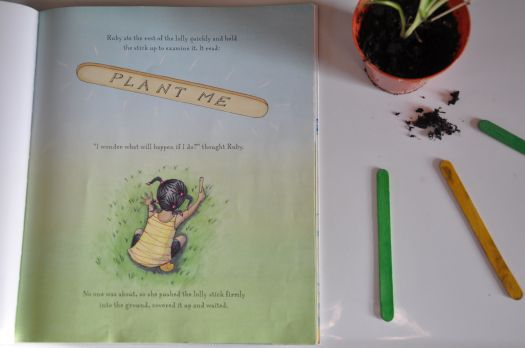
Ruby Nettleship and the Ice Lolly Adventure by Helen and Thomas Docherty is one of the most imaginative, fun and gloriously silly books I’ve ever read. The story begins when the single, remaining swing in Ruby’s poorly-maintained local park breaks. The other children head for home, but Ruby stays and meets a mysterious ice-cream van. The proprietor gifts Ruby her last ice lolly and on finishing it, Ruby notices that the stick says, ‘plant me’.

ruby2

The choice of words here are so perfect – mimicking the ‘eat me/drink me’ instructions of Alice in Wonderland. Ruby dutifully pushes the stick into the earth and is rewarded by a large tendril of rainbow-coloured vegetation which begins to sprout play-equipment. Responding to Ruby’s imagination, the play-park spreads out across the city, bringing everything to a standstill. Instead of being cross, all the grown-ups begin to join in, leading to a glorious, chaotic mess of adults, zoo animals and shopping-trolley roller-coasters!

Eventually, the mayor – who bears a rather striking resemblance to the ice-cream van proprietor – intervenes and Ruby sends the play park home. Soon, the neglected play-equipment the book began with is repaired by the council and Ruby and her friends can play there safely.

ruby3

I love pretty much everything about this book: that Ruby genuinely feels like a child – forgetting, but meaning to, say thank you at multiple points; the completely whimsical story; the colourful, rainbow illustrations and this ‘Wonderland’-ish sense that Something Is Happening.

One of the Story Sacks I made focused on this book.

ruby nettleship

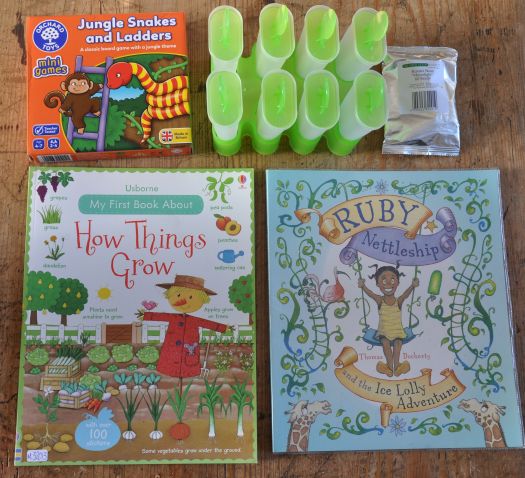
With this book, I included another called How Things Grow by Usborne. There was also a set of reusable lolly moulds, some beans and a game of snakes and ladders (known colloquially in my region as ‘chutes and ladders’, chute being the dialect word for a slide).

To go with this, I prepared a sheet of ideas for discussion and games – you can download it here: Ruby Nettleship PDF Download

If you haven’t already got a copy of snakes and ladders, you can print one here for free. It’s in black and white so won’t eat up lots of ink, and you can colour it in afterwards! Alternatively, you could always make your own, either by drawing a grid and adding your snakes and ladders over the top, or by sticking squares of paper onto a larger sheet. After that, you only need dice and a few counters (anything will do – buttons, small figurines, tiddlywinks etc). Lolly moulds can be purchased cheaply, or you can improvise and make your own from plastic beakers (where the rim is wider than the foot) with a plastic spoon, or you can push a plastic spoon through the lid of a small yogurt pot, removing both lid and pot when you want to eat it.

In place of the beans, you can use dried peas from any dried soup mix. Legumes are particularly good for the growing experiment outlined on the above PDF but any other large seeds you have to hand should work too, whilst information about how plants grow can be found on Wikipedia, or BBC Bitesize.

I’d love to see some pictures of any Snakes and Ladders games you manage to make – why not share them on The Inquisitive Newt facebook page?

Farn ❤