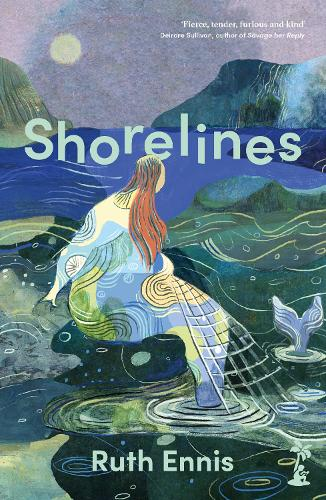
Shorelines by Ruth Ennis 

It’s been a while since I accepted a book to review – life has been incredibly busy over the last year! – but I just couldn’t resist the opportunity to dive into Shorelines by Ruth Ennis.

The lovely people at TheWriteReads described this book as a reimagining of HC Andersen’s ‘The Little Mermaid’.

This YA fantasy novel in verse follows Muireann’s story.

Between a dying ocean and a divided world, a mermaid must choose between the sea that made her and the surface that might break her – in this stunning novel in-verse.

Muireann is a mermaid – fierce, curious, and proud of the body that keeps her warm beneath the waves. But life in the ocean is becoming impossible. The merfolk are at war with climate change that has ravaged the sea: food is scarce, and her twin sister was killed in a mass-fishing net. With her mother lost in grief and her world falling apart, Muireann dreams of escaping to the surface.

But the human world isn’t the haven she hoped for. It’s colder, crueler – and here, her large body is seen not as strength, but as something to be ashamed of. Muireann must find her voice and decide where she belongs –  beneath the waves, or above them.

Firstly, I love that Muireann is fat; that all the merfolk are. It feels so incredibly logical, given the survival mechanisms of marine mammals. I also love how strong her voice is – when I read novels in verse, I often find that if they’re told in first person, the poetry sort of overrides the sense of the character. That doesn’t happen at all here.

I love the layout of the poetry – the way that words and shapes interact. Here are a couple of examples that I thought were especially wonderful;
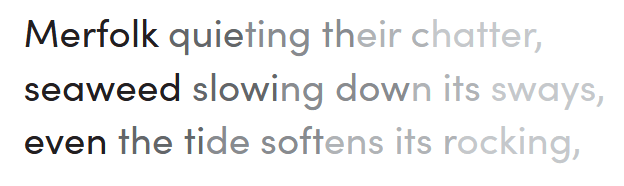
and
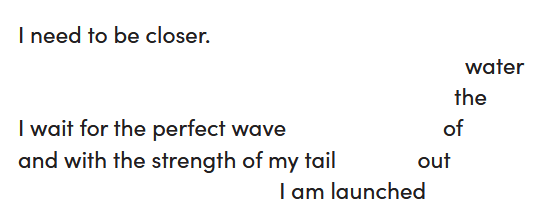
In particular, this following poem really stood out to me. The alignment of the paragraphs to portray a conversation is so clever! No need for quotation marks, disrupting the very clean aesthetic of the verse that’s upheld throughout.
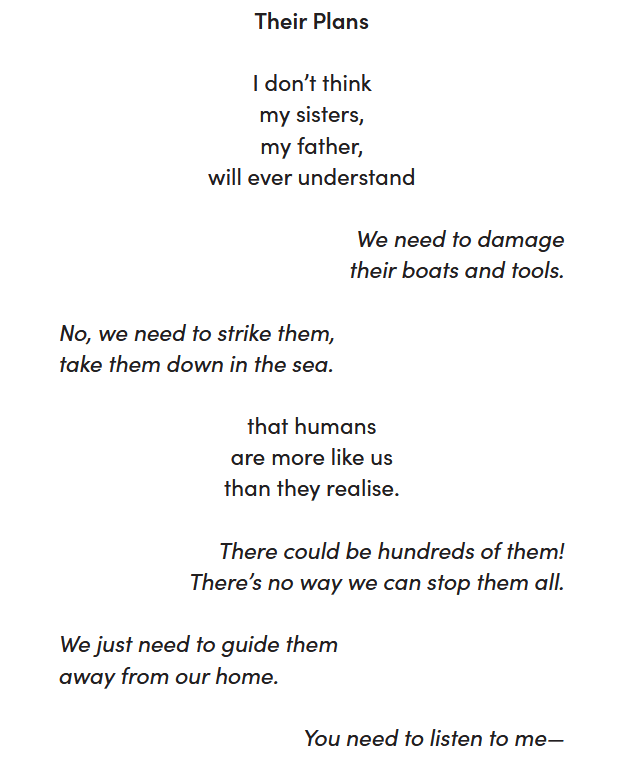
That said, the layout can get a little challenging at times. I found the following segment took a few reads before I figured out how it was intended to be read (i.e. bottom to top… I think). I wouldn’t necessarily want to change the format – I think it works so well as part of the metaphor of Muireann rising to the surface – but I might have liked an illustration that led the eye on this page, or at least something as a visual clue for where to start.
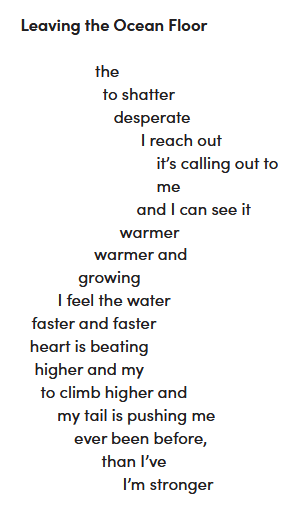
I think in general, that would be my main criticism of the book – the illustrations are beautiful and fit the tone fantastically, but I think there could have been a little more cohesion in how they were used.

It’s a minor point though, and it’s really all I’ve flagged as I read the book. I would still – and have already – recommend this to friends and family. As ever, I don’t really believe that children’s books should be confined to being read by children only, so I’ve sent links to this to numerous adult friends. It really is a spectacular offering in the ‘fairytale retellings’ genre. Along with Cinder House by Freya Marske (Cinderella), it’s possibly my absolute favourite.

A note on the ending: This book follows the HC Andersen version of The Little Mermaid, not the Disney one. It does so beautifully, I might add, and as someone who spent a lot of time at university studying Andersen, there’s a sense of ‘Finally!’ to this ending for me. I do understand, though, that not everyone is a lover of the bitter-sweet, so I do think it needs saying.

I would love to hear your thoughts on the different endings to The Little Mermaid, and I would love to hear of any other particularly good fairytale retellings you know of! Comments are always lovely, and it’d be great to chat books with people! Alternatively, you can find me over on Bluesky 🙂

Much love!

Fran xx

I’ve set up a ‘bookshop’ of sorts, over on Bookshop.org, so that I can point you to somewhere to buy that isn’t Amazon. I get a small commission for any sales made there. This helps to support me running this blog. If you’d like to get your copy of Shorelines this way, please just click here. If you’d like to support the running costs of this website without buying a book, you can do so here. Thank you.
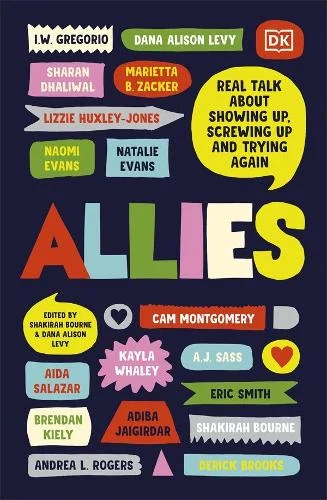
Allies: Real Talk About Showing Up, Screwing Up, And Trying Again by Shakirah Bourne and Dana Alison Levy

I’ve spent the last month highlighting books about LGBTQIA+ issues and/or by LGBTQIA+ authors:

The Secret Sunshine Project
Jamie
Glitterboy
Boy Like Me
Cottonopolis
Bloom

And while all of these books are AMAZING, I wanted to close out the month with an action – something that people could do in the face of the increasing demonisation of – specifically the trans community but also in general all – LGBTQIA+ people.

I first came across Allies: Real Talk About Showing Up, Screwing Up, And Trying Again by Shakirah Bourne and Dana Alison Levy in a shorter format, as one of the £1 World Book Day books. The title of the book generally explains what it does – it speaks about the need to sit with discomfort and let it move us to change, rather than to anger.

So often, so much of the discord we see in the world comes from peoples’ own discomfort at being wrong, where instead of listening and saying ‘sorry, I made a mistake’, they double-down on their previous assertions. This book teaches young people how to move past those feelings, and how to decentre themselves and their hurt in these conversations.

So, now that Pride month is over, what are we going to do going forward?

If you read no other books that I’ve recommended over June, I’d love it if you’d read this one – or even the £1 World Book Day abridged copy. In times like these, allyship is vital – especially for the trans community.

As for me, I’m going to continue seeking out books by LGBTQIA+ authors, so that I can continue to highlight them throughout the coming 12 months. If you’re an author or a publisher, and you have a book with queer themes for children and teens that you’d like me to review, please get in touch – especially books past their first flush of youth – I know how important sustained publicity is.

___

I’ve set up a ‘bookshop‘ of sorts, over on Bookshop.org, so that I can point you to somewhere to buy that isn’t Amazon. I get a small commission for any sales made there. This helps to support me running this blog. If you’d like to get your copy of Allies this way, please just click here. If you’d like to support me without buying a book, you can do so here. Thank you.

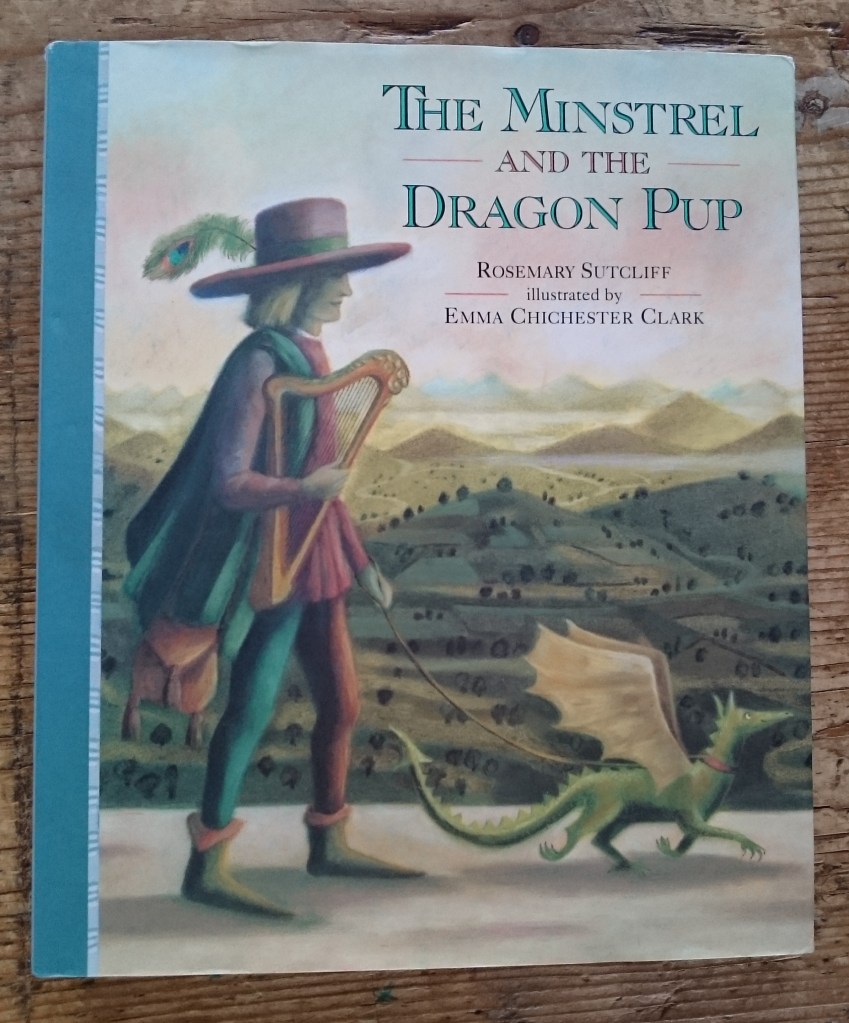
The Minstrel and The Dragon Pup by Rosemary Sutcliff

This is another one of our charity shop finds. And I know I say this about almost all of the books I discuss here, but this one really is one of my favourites.

Perhaps best known for The Eagle of the Ninth, Rosemary Sutcliff has also written a number of books about the Arthurian legends, and I feel as though The Minstrel and The Dragon Pup very much draws inspiration from these. That’s not to say that this is a stereotypical medieval fantasy story – there are no swords, or sorcery. At its core, the tale is about a singing musician who finds a dragon’s egg, hatches it, raises it, and loves the resulting dragon.

And it’s that love which makes this such a rare tale.

I’ve read a lot of fantasy over the course of my life, and I’ve found that if the gender roles of knights and damsels are challenged – and this is rarer than you’d think – that it’s done by placing women in a traditionally masculine role i.e. the Knight Alanna in Tamora Pierce’s The Song Of The Lioness Quartet.

Don’t misunderstand me – that’s brilliant too. But this is honestly the only instance I can think of – off the top of my head, in any case – in which there’s a boy in a caring role, who undertakes a quest for non-romantic love.

The plot follows The Minstrel – a young man who sings for his supper as he tours the kingdom. One day, he finds a dragon egg, just as it’s about to hatch. He cares for the dragon pup – who he names Lucky – and the two form a loving, gentle friendship. One night, though, Lucky is stolen. The Minstrel goes searching for him but to no avail. His songs become sadder and he grows hungrier. Time passes, until a chance encounter leads him to Lucky – a prisoner now in the king’s menagerie. The Minstrel then uses his skills as a song-writer, and the love he feels for his friend, to solve the king’s dilemma and win the freedom of the dragon pup.

Aside from the obvious ‘quest for the love of a friend’, this book is also unique in that the happy ending doesn’t involve vanquishing a foe – neither with violence nor with trickery. It involves healing with music. There are no villains in the work – the thief who steals Lucky is only trying to survive in a harsh world and the Minstrel doesn’t seek vengeance.

Yes, the questing hero is still male, but it feels different to the usual ‘hero saves damsel’ tale on account of the love which drives the search being parental, fraternal, and philial. It’s more Finding Nemo/Finding Dory than any usual fantasy. It deals with the family-we-choose, and I feel like in the context of a blended family, or an adopted family, that this would be a great book to use in a discussion about how kin doesn’t necessarily mean blood-relative.

The story is a gentle subversion of a whole host of fantasy tropes, and as a result, it becomes its own thing entirely.

Have you read The Minstrel and The Dragon Pup? Or any of Sutcliff’s other works? Can you think of any other fantasy stories which avoid the usual stereotypes?

As ever, I’d love to hear your recommendations.

Farn ❤

Dear Ijeawele by Chimamanda Ngozi Adichie

UPDATE: 

It has been brought to my attention that Chimamanda Ngozi Adichie has been quoted as saying that trans women are not women. Adichie went on to try and clarify her comments. You can read about the incident here.

I just wanted to be very clear that I fully support all of my trans and non-binary siblings. 

1558792802098277108116

Dear Ijeawele by Chimamanda Ngozi Adichie is a book that I wish I’d had in my life a long time ago. 

Whilst not technically a children’s book, I decided to include this on The Inquisitive Newt for two reasons.

Firstly, because I wish I had read this during my teenage years, when I was stumbling into my initial romantic relationships. I feel that having reasonable expectations, printed in black and white, would have given me permission to advocate for myself and my rights within the ‘partnerships’ more.  I plan to give a copy to Daughter when puberty takes hold.

Secondly,  I included it because I would have loved to read it after having given birth.  I came to a lot of the conclusions myself, but I often felt alone in my convictions regarding feminism and motherhood.  Ironically,  given that I’ve categorised this review as my first ‘parenting’ title,  I especially loved the section regarding the use of ‘parenting’ as a verb.

I really love the tone of the text – that it was adapted from a letter gives it an enormous warmth and immediacy. I’ve read a lot of books about feminism but they can often feel… Academic,  rather than practical.  This one felt like a conversation with a friend, which I suppose it is.

Are there any books you wish you had come across sooner? Are there any you plan to read/gift to your children for this reason?

Farn ❤