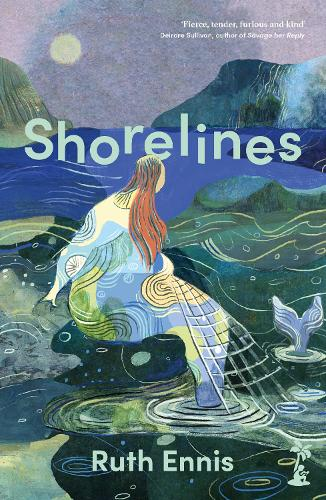
Shorelinesย byย Ruth Ennisย 

It’s been a while since I accepted a book to review – life has been incredibly busy over the last year! – but I just couldn’t resist the opportunity to dive into Shorelines by Ruth Ennis.

The lovely people at TheWriteReads described this book as a reimagining of HC Andersen’s ‘The Little Mermaid’.

This YA fantasy novel in verse follows Muireann’s story.

Between a dying ocean and a dividedย world, a mermaid must choose betweenย the sea that made her and the surface thatย might break her โ€“ in this stunning novelย in-verse.

Muireann is a mermaid โ€“ fierce, curious,ย and proud of the body that keeps her warmย beneath the waves. But life in the ocean isย becoming impossible. The merfolk are atย war with climate change that has ravagedย the sea: food is scarce, and her twin sisterย was killed in a mass-fishing net. With herย mother lost in grief and her world fallingย apart, Muireann dreams of escaping to theย surface.

But the human world isnโ€™t the haven sheย hoped for. Itโ€™s colder, crueler โ€“ and here, herย large body is seen not as strength, but asย something to be ashamed of. Muireann mustย find her voice and decide where she belongs –ย  beneath the waves, or above them.

Firstly, I love that Muireann is fat; that all the merfolk are. It feels so incredibly logical, given the survival mechanisms of marine mammals. I also love how strong her voice is – when I read novels in verse, I often find that if they’re told in first person, the poetry sort of overrides the sense of the character. That doesn’t happen at all here.

I love the layout of the poetry – the way that words and shapes interact. Here are a couple of examples that I thought were especially wonderful;
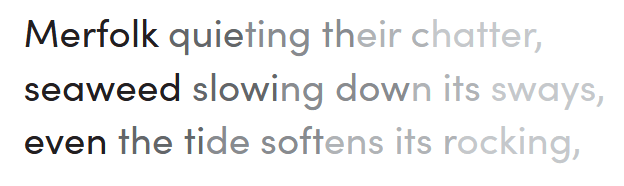
and
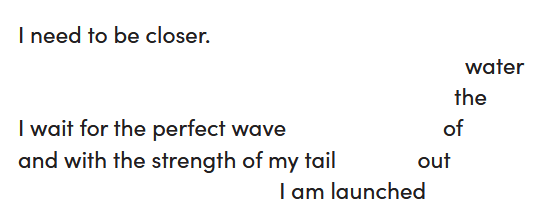
In particular, this following poem really stood out to me. The alignment of the paragraphs to portray a conversation is so clever! No need for quotation marks, disrupting the very clean aesthetic of the verse that’s upheld throughout.
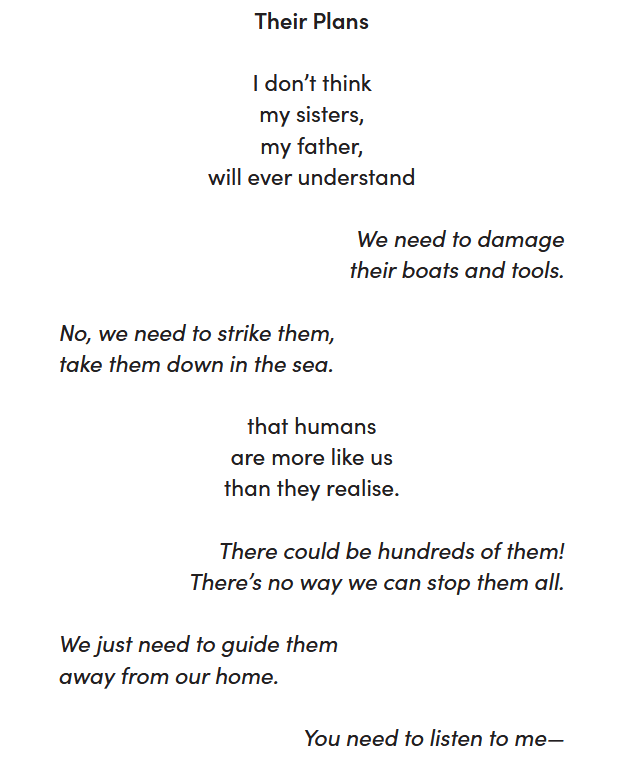
That said, the layout can get a little challenging at times. I found the following segment took a few reads before I figured out how it was intended to be read (i.e. bottom to top… I think). I wouldn’t necessarily want to change the format – I think it works so well as part of the metaphor of Muireann rising to the surface – but I might have liked an illustration that led the eye on this page, or at least something as a visual clue for where to start.
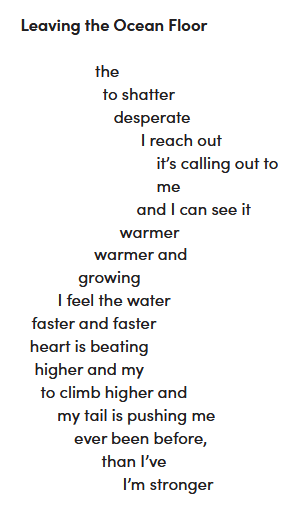
I think in general, that would be my main criticism of the book – the illustrations are beautiful and fit the tone fantastically, but I think there could have been a little more cohesion in how they were used.

It’s a minor point though, and it’s really all I’ve flagged as I read the book. I would still – and have already – recommend this to friends and family. As ever, I don’t really believe that children’s books should be confined to being read by children only, so I’ve sent links to this to numerous adult friends. It really is a spectacular offering in the ‘fairytale retellings’ genre. Along with Cinder House by Freya Marske (Cinderella), it’s possibly my absolute favourite.

A note on the ending: This book follows the HC Andersen version of The Little Mermaid, not the Disney one. It does so beautifully, I might add, and as someone who spent a lot of time at university studying Andersen, there’s a sense of ‘Finally!’ to this ending for me. I do understand, though, that not everyone is a lover of the bitter-sweet, so I do think it needs saying.

I would love to hear your thoughts on the different endings to The Little Mermaid, and I would love to hear of any other particularly good fairytale retellings you know of! Comments are always lovely, and it’d be great to chat books with people! Alternatively, you can find me over on Bluesky ๐Ÿ™‚

Much love!

Fran xx

I’ve set up a โ€˜bookshopโ€™ of sorts, over on Bookshop.org, so that I can point you to somewhere to buy that isnโ€™t Amazon. I get a small commission for any sales made there. This helps to support me running this blog. If youโ€™d like to get your copy of Shorelines this way, please just click here. If youโ€™d like to support the running costs of this website without buying a book, you can do so here. Thank you.
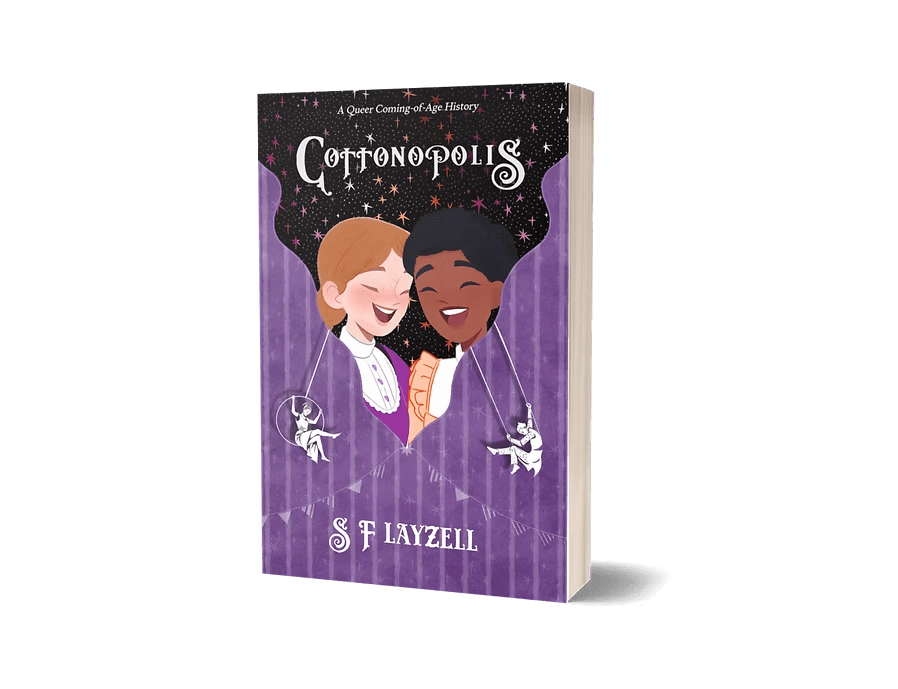
Cottonopolis by SF Layzell


A few weeks back, I took part in a Northodox Pride Party author panel, chaired by the lovely SF Layzell – which was absolutely brilliant for so many reasons. Not only did I get to chat to some other great authors, but I also got to hear about Layzell’s book, Cottonopolis. AND I was lucky enough to get an extract to post here!!

Recently longlisted for the Little Rebels Children’s Book Award 2025, Cottonopolis is a story of family, friendship and first love, with a twist of magic, set in Victorian Manchester. It’s the story of Irish mill girl Nellie Doyle, who works hard to take care of her little brothers, and her growing friendship with Chloe Valentine, who is in search of a better life away from Manchester’s notorious workhouse.

In the extract below, Nellie and Chloe meet for the first time. Both have stepped away from their work, enticed by the sight and smells of a new bakery stacked high with goods neither of them can afford.


I follow the pickpocketing boy through the crowd, hoping to see the bakery for myself. What does the best bread look like? It must be something to bring such a crowd.

A shiver runs through me as the bakery door swings open and a sweet, full smell drifts out. Itโ€™s heaven. I can taste it!

I feel like I can almost reach out and grab a handful of it to take home in my pocket. Just imagine the boysโ€™ faces, if I could reach into my pocket and pull out a fistful of this smell, shining like gold, and let my fingers ease apart ever so slightly to let just a little of it out, unfurling and filling their little nostrils.

Iโ€™m pressed forward by a sudden rush of people and part of me finds a little pleasure in knowing that some of them will find their purses lighter than they expected when they come to pay. People leaving the shop push in the opposite direction to the rest of the crowd, making me feel like a pebble lost deep in the swirling sludge of the Medlock. As they pass, I get a faint whiff of the sweet smelling delights every one of them carries, wrapped up in tiny individual boxes, each tied with a thin black velvet ribbon.

After what seems like an age (and Iโ€™m sure Iโ€™m going to be in trouble when I get back, though I canโ€™t seem to pull myself away), I reach the big shop window. The window is a wonder in itself, a smooth clean sheet of glass. A sea of breads and cakes spreads out before me, stretched and cut and moulded into beautiful shapes. There are sticky round buns coated in syrup and dusted with spices, plaits of flaky pastry sprinkled with tiny white nuts and purple flowers made out of sugar, and cut-out golden discs layered with firm custard, fresh red fruits and dollops of yellow cream.

โ€˜Makes you sick, doesnโ€™t it,โ€™ a tight angry voice rings out beside me. I jump back from the window, the spell broken, and find myself staring into the face of a girl about my age. The way she speaks is sharp and quick but full of feeling. English. Like the pickpocket boy. Thatโ€™s where the similarities end though.


____

Sounds brilliant, right? Here’s the blurb, in case you want any more information….

Welcome to 1840s ManchesterTwelve-year-old mill girl NELLIE DOYLE faces eviction and starvation when her father loses his job. But growing up in the notorious Manchester slum of Little Ireland has made her plucky. She befriends CHLOE VALENTINE and has a chance meeting with a circus owner who seemingly grants seven wishes. They embark on a journey to improve their circumstances. Amidst wishes for peace, freedom, and family reunion, Nellie realizes her growing feelings for Chloe, learning that magic doesnโ€™t always work as expected, and sometimes, you must create your own.

Aaaand, here’s some more details about the Little Rebels awards:

I’m waiting for pay day, and then I’m going to grab myself a copy to review. I just wanted to highlight this book as part of the many amazing LGBTQIA+ books that I’m showcasing this June.

___

I’ve set up a ‘bookshop‘ of sorts, over on Bookshop.org, so that I can point you to somewhere to buy that isn’t Amazon. I get a small commission for any sales made there. This helps to support me running this blog.

If you’d like to get your copy of Cottonopolis, please just click here to support the publisher, or to buy from the bookshop Queer Lit. If you’d like to support me without buying a book, you can do so here. Thank you.

DISCLOSURE: My own book – When The Giants Passed Through – will also be published by Northodox Press.

Tyger by SF Said and Dave McKean

Before I start reviewing this book, I’d like to tell you a short story about our local landscape.

In the 1800s, pushed from their homes by the Improvement practices that estates were bringing into force at this time, a group of crofters set up home on the Commonty (or common land) of Bennachie. This so-called ‘squatters settlement’ lasted for around 50 years before three lairds decided that the inhabitants had made this land fertile enough to be useful, at which point, said lairds made to claim it. In celebration of their success, they capped the hill with a carved stone – something that we know to this day as ‘the thieves’ mark’.

A photo I took of the โ€œThieves Mark”. This is carved into the bedrock on top of Bennachie’s peak, Mither Tap . The โ€œBโ€ stands for Balquhain, the โ€œPโ€ for Pittodrie, and the โ€œLEโ€ for Logie Elphinstone. The stone is dated 1858 although the Court of Session didn’t approve the sectioning of the land until 1859. Bit cocky.

You can read more about their story here.

So why am I telling you this?

Tyger by SF Said follows the story of Adam – a young immigrant boy living in a British Empire London. Adam discovers a mystical tyger, hiding in a rubbish dump and pledges to help said tyger face an encroaching danger which threatens its life. Using his talent for art, and through speaking to people across various echelons of this eerily familiar Empiric Britain, Adam and his friend Zadie aim to avert disaster.

Again – what’s with the story about the commons?

The theft of common land by the powerful is a large theme of Said’s book, and it stuck with me on account of my ties to the Bennachie colony. Not only do I live within drivable distance, I’ve also helped out on digs close to this site, and researched the history of the place for my archaeology degree. A combination of the local past and the empathy I felt for Said’s characters really stirred something deep inside me as I read this, and I found myself with a bubbling anger at what had been done to the Bennachie ‘squatters’. When I tried to express this rage at the theft of common land to friends, I was met with blank stares. So few people now understand that there used to be swathes of countryside set apart for people to use as they needed – whether for grazing livestock, or gathering stone, or in the case of Bennachie, for living on when rents became impossible. The violence of the abolition of common land could be seen in the archaeology of this settlement – crockery lay smashed, just beneath the surface from where residents had been dragged from their homes for refusing to pay rent. To quote from the link above; ย it is believed that a sheriffโ€™s officer, policeman, factor, and estate employees would pull down a course of masonry so that the wall [of residents’ houses] would collapse.

This isn’t something that took place within the distant past – these are events from our great-grandparents’ living memory. The theft of the commons is something that shapes our daily lives now. I love how Tyger brings this part of our history into focus, and can open discussions about land ownership, right-to-roam, and trespass. The need for connection between people and the earth matters now more than ever, and without space in which to foster that connection – space which is accessible to all and doesn’t depend on income – is absolutely vital.

And then there’s the elements of the book which tackle the concepts of national identity, the role of the outsider, the desire to conform…. honestly, there are dissertations-worth of things I could say about this book and how important it is that young people read it. Colonialism impacts all aspects of our lives, and it’s crucial that we understand that so we can take steps to counter it.

I’m going to be reviewing a book about the history of the British Empire soon – Story of Now – but as I think it goes hand-in-hand with Tyger, I thought I would mention it here. These books in combination would make for an incredible addition to anyone teaching the Victorians. Before, or while reading it, I highly recommend looking up where your local common land used to be, or just looking up the Cambridge Cows.

Can you think of any other books which deal with common land and the theft of it? Do you know of any other good books for children, about the harms of the British Empire? I would love to hear your thoughts.

— Fran xxx

I’ve set up a ‘bookshop‘ of sorts, over on Bookshop.org, so that I can point you to somewhere to buy that isn’t Amazon. I get a small commission for any sales made there. This helps to support me running this blog. If you’d like to get your copy of Tyger this way, please just click here. Thank you for your support.

The Legendary Mo Seto by A.Y. Chan – Write Reads Blog Tour

To date, I don’t think I’ve ever reviewed the same book twice, but since Youngest wanted to review The Legendary Mo Seto the first time round, I jumped at the chance to add my own thoughts about the book to this second blog tour.

I’ve said already that everyone in my family – even my non-reading husband! – loved this book. Whilst we all enjoyed the plot, for me, the characters were what really made this story a special one. I loved the dynamic between Mo’s parents, and the way that each of her parents had a very different type of relationship with her – it’s one of those rare books where the family felt real rather than a cast of actors performing the set roles of mother and father. I loved that the adults in the books all had pasts – pasts which included hopes and regrets which impacted the way they dealt with the events of the plot.

And Gramps! I loved Gramps so much – I’ve been searching for such a long time for fictional older male characters who show love and sorrow in ways other than shutting their loved-ones out of their lives. For anyone (like me) who got wildly frustrated at Carl in Disney’s Up! for pushing Russell away, Gramps is the perfect antidote.

I loved the detail in the character building – that every film with Cody Kwan in was Mo’s favourite. I loved that Nacho drew a tattoo on his hand in Sharpie (who didn’t, as a teenager?!). I loved the complexity of Dax – Mo’s rival – and the way in which the author managed to tell so much of his story in a few pages, without it feeling like exposition. The dialogue there was *chef’s kiss*. I loved the way that Nacho’s family and Mo’s sort of bled into one another – the way that families do when children have known one another since the age of five.

The entire thing left me hoping for a sequel – I want to be able to go back and revisit these characters which feel real enough to come across as old friends.

And it has been a LONG time since any book made me feel that way.

Have you had the chance to read The Legendary Mo Seto yet? Do you know of any other books about martial arts movies that I can pass to the rest of my family who are absolutely hooked?

___

I’ve set up a ‘bookshop‘ of sorts, over on Bookshop.org, so that I can point you to somewhere to buy that isn’t Amazon. I get a small commission for any sales made there. This helps to support me running this blog. If you’d like to get your copy of The Legendary Mo Seto this way, please just click here. Thank you for your support.

The Remembering by Dione Orrom – Random Things Blog Tour

There’s a lot to talk about when it comes to The Remembering by Dione Orrom, and honestly, I’m not really sure where to start.

Simply put, this book is a journey through a dying landscape, in a last-ditch attempt at saving the world from the environmental mistakes of humanity. There were shades of The Neverending Story to this – a race through a collapsing world which emphasises the beauty of things through their absence. There’s also what feels like a nod to The Lion, The Witch, and the Wardrobe – a collection of disparate animals coming together to fight against dark forces. There’s so much to like about this book and so much that makes it timely.

But let’s start at the beginning which – honestly? – is going to put some people off. So, while I’m saying this, please keep in mind that I loved the rest of the book. Really, actually loved it. The thing is though, the first three chapters are… slow. And in chapter 2, especially, there’s a lot of exposition through conversation. That’s not necessarily a bad thing, but when the rest of the book is so fluid and pacy, it felt jarringly clunky. Youngest child (9) gave up, and Eldest (13) said it was a close call.

I think this is partially down to how rich the lore of Orrom’s world is – how much there is to say about every aspect of what’s going on. As the story continues, the quick pace and sense of urgency makes the book very difficult to put down. I read a digital copy, and though the first 20 pages or so were difficult to get through, I found myself at 72% finished by the point it was so far Past My Bedtime that I had to stop reading. I finished the rest first thing the following morning.

As I said above, this story pulls together lots of elements from classic children’s literature. In addition to The Neverending Story, and C.S. Lewis’s cornerstone of children’s fantasy, I could see shades of Michelle Paver’s Wolf Brother series in the characters of Snakeskin and Aster. There are echoes of Elidor in the way that the children only ever know part of what’s going on – there’s the sense that they’re minor characters in a much larger adventure. Some of these books, are amongst my all time favourites.

I think though, as a keen forager, that what I loved most about The Remembering was the way that time-travel seemed to work through the mitochondrial root network that connects tress to fungi. I thought this was absolutely genius and loved the way that Orrom continued this tree-inspired lore throughout. I loved that the trees of the council each had their own personalities and roles to play. Honestly, chef’s kiss to all the lore of this world.

I spoke a little while ago about dystopian climate fiction and how I don’t think it’s the way to engage people with the realities of climate crisis. I passionately believe that we need a future to fight for, more than we need one to steer from. Though it’s never explicitly stated whether Snakeskin and Aster exist in the past or the future of Jack’s time, the closeness that they share with the natural world is something that we can all aim for. Perhaps not literally speaking to the trees – though you never know – but by engaging with the world as a part of it, rather than master of it.

To sum up – if you’re reading this as an adult, stick with it past the first few chapters – you won’t be disappointed. If you’re reading this with children, perhaps read the first five chapters or so together, before handing the book across*.

What are your favourite climate fiction books? I’d love to read some – especially those which offer a vision of hope, rather than dystopia.

___

*This works for Youngest child. Sometimes they’re** convinced that a book with smaller writing is ‘too hard’ so we read the first few chapters together (take a page, turn about), and by the time we get to chapter 2 or 3, kiddo is ready to read the rest alone.

**I’m using the singular ‘they’ pronoun for anonymity, rather than gender reasons, though if you do have recommendations on books for non-binary children, I’d love to hear them.

___

I’ve set up a ‘bookshop‘ of sorts, over on Bookshop.org, so that I can point you to somewhere to buy that isn’t Amazon. I get a small commission for any sales made there. This helps to support me running this blog. If you’d like to get your copy of The Remembering this way, please just click here. Thank you for your support.