Jamie by LD Lapinski

Jamie by LD Lapinski is an absolute beauty of a book. When Wonderland Books asked ‘Which children’s book have you recently read do you wish had existed when you were a child?’ this was the story which sprung to mind.

Jamie follows the eponymous, non-binary character as they transition up to secondary. With a town that only has an all girls- or all boys-school, Jamie needs to make a decision as to which they’ll attend. Sick of being forced into an arbitrary binary, Jamie and their friends decide to make a stand…

I’m never quite sure as to how much of myself to put into these reviews – it’s often difficult to strike a balance, given that books are art, and art solicits emotional responses. In this case though, I think it probably adds something to say that as someone who never really conformed to gender stereotypes, this book spoke to a part of me that as a child, would have found great comfort and solidarity in the character of Jamie. Am I non-binary? I don’t think so; agender, probably, but labels never seem to fit me with ease. Still, seeing someone defy the forced and artificial segregation of children would have soothed some part of my soul in early adolescence. I would have felt less broken growing up, and less at odds with the world.

There’s the old adage that we cannot be what we cannot see, and so books like this one are absolutely essential for young people. With such a small percentage of the population being trans, non-binary, and agender, it’s likely that a lot of young people will grow up without personally knowing anyone impacted by the themes in this book. For those who are gender non-conforming, readers can find a friend of sorts in Jamie. For those who aren’t, Jamie is a wonderfully sympathetic figure to root for, and can hopefully show that those outside the binary aren’t any kind of threat, despite the loud rhetoric in this increasingly transphobic world.

The clear importance of the book aside, Jamie is just a crackingly good story. It’s told with the humour that makes Lapinski’s books so deeply enjoyable, as well as the heart which makes them stay with you. The families seem real and… well, familiar, rather than the polished and sanitised versions that are so common in children’s literature. Parents are imperfect and relatable for adult readers, though are always clearly loving and doing their best.

Usually, when we finish a book, we pass it along to school so that a) we don’t drown in the number of books that pass through this house, and b) school’s library stays current. In this case, neither I nor the children could part with our copy of Jamie. So I bought school their own one. I can’t recommend this book enough.

Which begs the question: Which books do you wish existed when you were a child? Which books came into your life at just the right moment? I’d love to have a read.

___

I’ve set up a ‘bookshop’ of sorts, over on Bookshop.org, so that I can point you to somewhere to buy that isn’t Amazon. I get a small commission for any sales made there. This helps to support me running this blog. If you’d like to get your copy of Jamie this way, please just click here. If you’d like to support me without buying a book, you can do so here. Thank you.
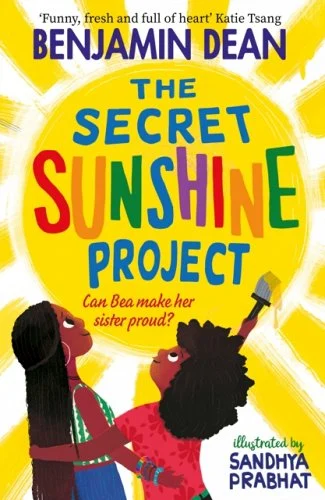
The Secret Sunshine Project by Benjamin Dean and Sandhya Prabhat

The Secret Sunshine Project by Benjamin Dean and Sandhya Prabhat is one of the amazing novels that my children got in their advent calendar from the superb Wonderland Books.

The story follows Bea, as her happy family of four become a sadder family of three. After the death of her dad, Bea’s family starts to struggle financially and it becomes necessary to move in with Bea’s grandmother – far away from London in the countryside.

The countryside – miles and miles from London Pride, where Bea’s family was last happy. Miles and miles from the one event that Bea and her sister Riley were looking forward to. So Bea decides to take matters into her own hands, and begins The Secret Sunshine Project. If she and Riley can’t go to Pride, she’s going to bring Pride to this village – whether her gran’s arch-nemesis and head of the village council likes it or not!

I really, really loved this book. Though it dealt with incredibly serious subjects – family death, financial instability, systemic racism, as well as trans- and homo-phobia – The Secret Sunshine Project never once felt hopeless. Whilst I loved Norah’s Ark, there were times when I needed to put the book down and take a moment because of the subject matter, but that didn’t once happen here. I read the whole thing in a single, joyful sitting, and came away from it feeling uplifted.

The book doesn’t end perfectly, and any resolution the characters enjoy is a temporary respite in the grand scheme of things, but it felt real, and honest, and hopeful nevertheless.

The ‘dead parent’ trope is one that’s used fairly commonly in children’s fiction – and I should know, I used it myself in my upcoming novel – but it’s sometimes feels like it isn’t properly dealt with. I thought The Secret Sunshine Project did an absolutely wonderful job of this though.

What are your favourite books for Pride month? I would especially love to hear about those by LGBT+ authors – especially trans authors at this time.

Fran ❤

I’ve set up a ‘bookshop‘ of sorts, over on Bookshop.org, so that I can point you to somewhere to buy that isn’t Amazon. I get a small commission for any sales made there. This helps to support me running this blog. If you’d like to get your copy of The Secret Sunshine Project this way, please just click here. Thank you for your support.

Tyger by SF Said and Dave McKean

Before I start reviewing this book, I’d like to tell you a short story about our local landscape.

In the 1800s, pushed from their homes by the Improvement practices that estates were bringing into force at this time, a group of crofters set up home on the Commonty (or common land) of Bennachie. This so-called ‘squatters settlement’ lasted for around 50 years before three lairds decided that the inhabitants had made this land fertile enough to be useful, at which point, said lairds made to claim it. In celebration of their success, they capped the hill with a carved stone – something that we know to this day as ‘the thieves’ mark’.

A photo I took of the “Thieves Mark”. This is carved into the bedrock on top of Bennachie’s peak, Mither Tap . The “B” stands for Balquhain, the “P” for Pittodrie, and the “LE” for Logie Elphinstone. The stone is dated 1858 although the Court of Session didn’t approve the sectioning of the land until 1859. Bit cocky.

You can read more about their story here.

So why am I telling you this?

Tyger by SF Said follows the story of Adam – a young immigrant boy living in a British Empire London. Adam discovers a mystical tyger, hiding in a rubbish dump and pledges to help said tyger face an encroaching danger which threatens its life. Using his talent for art, and through speaking to people across various echelons of this eerily familiar Empiric Britain, Adam and his friend Zadie aim to avert disaster.

Again – what’s with the story about the commons?

The theft of common land by the powerful is a large theme of Said’s book, and it stuck with me on account of my ties to the Bennachie colony. Not only do I live within drivable distance, I’ve also helped out on digs close to this site, and researched the history of the place for my archaeology degree. A combination of the local past and the empathy I felt for Said’s characters really stirred something deep inside me as I read this, and I found myself with a bubbling anger at what had been done to the Bennachie ‘squatters’. When I tried to express this rage at the theft of common land to friends, I was met with blank stares. So few people now understand that there used to be swathes of countryside set apart for people to use as they needed – whether for grazing livestock, or gathering stone, or in the case of Bennachie, for living on when rents became impossible. The violence of the abolition of common land could be seen in the archaeology of this settlement – crockery lay smashed, just beneath the surface from where residents had been dragged from their homes for refusing to pay rent. To quote from the link above;  it is believed that a sheriff’s officer, policeman, factor, and estate employees would pull down a course of masonry so that the wall [of residents’ houses] would collapse.

This isn’t something that took place within the distant past – these are events from our great-grandparents’ living memory. The theft of the commons is something that shapes our daily lives now. I love how Tyger brings this part of our history into focus, and can open discussions about land ownership, right-to-roam, and trespass. The need for connection between people and the earth matters now more than ever, and without space in which to foster that connection – space which is accessible to all and doesn’t depend on income – is absolutely vital.

And then there’s the elements of the book which tackle the concepts of national identity, the role of the outsider, the desire to conform…. honestly, there are dissertations-worth of things I could say about this book and how important it is that young people read it. Colonialism impacts all aspects of our lives, and it’s crucial that we understand that so we can take steps to counter it.

I’m going to be reviewing a book about the history of the British Empire soon – Story of Now – but as I think it goes hand-in-hand with Tyger, I thought I would mention it here. These books in combination would make for an incredible addition to anyone teaching the Victorians. Before, or while reading it, I highly recommend looking up where your local common land used to be, or just looking up the Cambridge Cows.

Can you think of any other books which deal with common land and the theft of it? Do you know of any other good books for children, about the harms of the British Empire? I would love to hear your thoughts.

— Fran xxx

I’ve set up a ‘bookshop‘ of sorts, over on Bookshop.org, so that I can point you to somewhere to buy that isn’t Amazon. I get a small commission for any sales made there. This helps to support me running this blog. If you’d like to get your copy of Tyger this way, please just click here. Thank you for your support.

The Legendary Mo Seto by A.Y. Chan – Write Reads Blog Tour

To date, I don’t think I’ve ever reviewed the same book twice, but since Youngest wanted to review The Legendary Mo Seto the first time round, I jumped at the chance to add my own thoughts about the book to this second blog tour.

I’ve said already that everyone in my family – even my non-reading husband! – loved this book. Whilst we all enjoyed the plot, for me, the characters were what really made this story a special one. I loved the dynamic between Mo’s parents, and the way that each of her parents had a very different type of relationship with her – it’s one of those rare books where the family felt real rather than a cast of actors performing the set roles of mother and father. I loved that the adults in the books all had pasts – pasts which included hopes and regrets which impacted the way they dealt with the events of the plot.

And Gramps! I loved Gramps so much – I’ve been searching for such a long time for fictional older male characters who show love and sorrow in ways other than shutting their loved-ones out of their lives. For anyone (like me) who got wildly frustrated at Carl in Disney’s Up! for pushing Russell away, Gramps is the perfect antidote.

I loved the detail in the character building – that every film with Cody Kwan in was Mo’s favourite. I loved that Nacho drew a tattoo on his hand in Sharpie (who didn’t, as a teenager?!). I loved the complexity of Dax – Mo’s rival – and the way in which the author managed to tell so much of his story in a few pages, without it feeling like exposition. The dialogue there was *chef’s kiss*. I loved the way that Nacho’s family and Mo’s sort of bled into one another – the way that families do when children have known one another since the age of five.

The entire thing left me hoping for a sequel – I want to be able to go back and revisit these characters which feel real enough to come across as old friends.

And it has been a LONG time since any book made me feel that way.

Have you had the chance to read The Legendary Mo Seto yet? Do you know of any other books about martial arts movies that I can pass to the rest of my family who are absolutely hooked?

___

I’ve set up a ‘bookshop‘ of sorts, over on Bookshop.org, so that I can point you to somewhere to buy that isn’t Amazon. I get a small commission for any sales made there. This helps to support me running this blog. If you’d like to get your copy of The Legendary Mo Seto this way, please just click here. Thank you for your support.

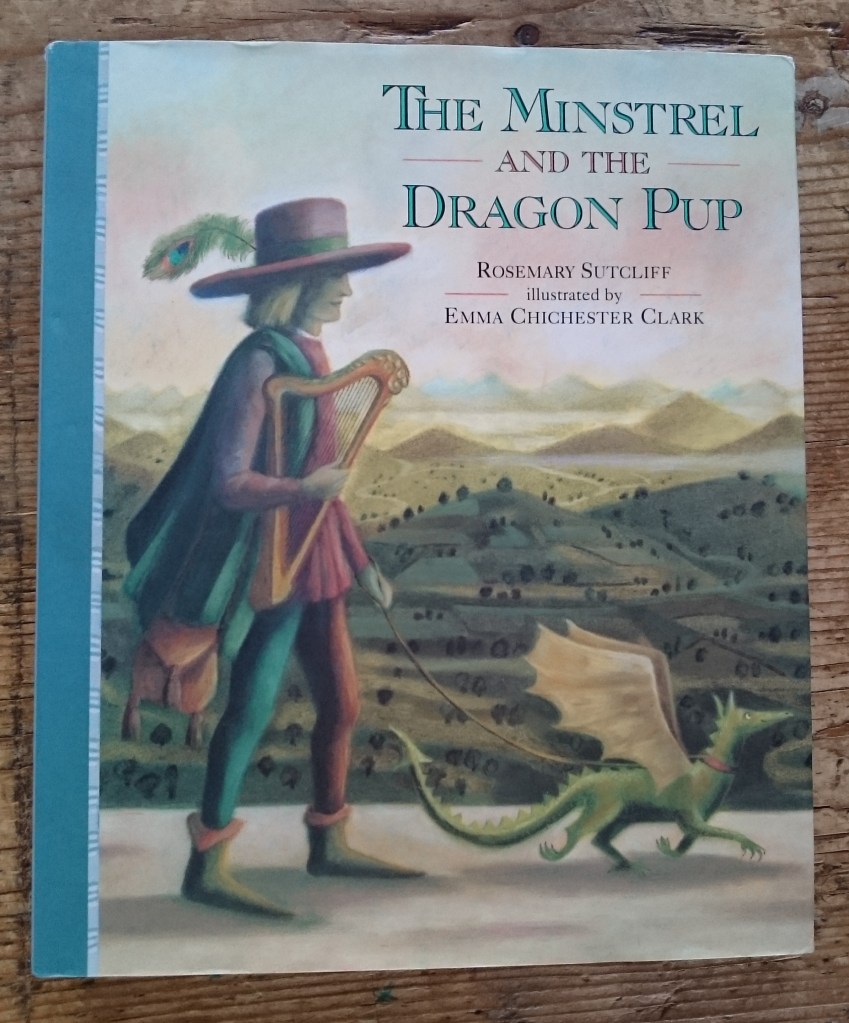
The Minstrel and The Dragon Pup by Rosemary Sutcliff

This is another one of our charity shop finds. And I know I say this about almost all of the books I discuss here, but this one really is one of my favourites.

Perhaps best known for The Eagle of the Ninth, Rosemary Sutcliff has also written a number of books about the Arthurian legends, and I feel as though The Minstrel and The Dragon Pup very much draws inspiration from these. That’s not to say that this is a stereotypical medieval fantasy story – there are no swords, or sorcery. At its core, the tale is about a singing musician who finds a dragon’s egg, hatches it, raises it, and loves the resulting dragon.

And it’s that love which makes this such a rare tale.

I’ve read a lot of fantasy over the course of my life, and I’ve found that if the gender roles of knights and damsels are challenged – and this is rarer than you’d think – that it’s done by placing women in a traditionally masculine role i.e. the Knight Alanna in Tamora Pierce’s The Song Of The Lioness Quartet.

Don’t misunderstand me – that’s brilliant too. But this is honestly the only instance I can think of – off the top of my head, in any case – in which there’s a boy in a caring role, who undertakes a quest for non-romantic love.

The plot follows The Minstrel – a young man who sings for his supper as he tours the kingdom. One day, he finds a dragon egg, just as it’s about to hatch. He cares for the dragon pup – who he names Lucky – and the two form a loving, gentle friendship. One night, though, Lucky is stolen. The Minstrel goes searching for him but to no avail. His songs become sadder and he grows hungrier. Time passes, until a chance encounter leads him to Lucky – a prisoner now in the king’s menagerie. The Minstrel then uses his skills as a song-writer, and the love he feels for his friend, to solve the king’s dilemma and win the freedom of the dragon pup.

Aside from the obvious ‘quest for the love of a friend’, this book is also unique in that the happy ending doesn’t involve vanquishing a foe – neither with violence nor with trickery. It involves healing with music. There are no villains in the work – the thief who steals Lucky is only trying to survive in a harsh world and the Minstrel doesn’t seek vengeance.

Yes, the questing hero is still male, but it feels different to the usual ‘hero saves damsel’ tale on account of the love which drives the search being parental, fraternal, and philial. It’s more Finding Nemo/Finding Dory than any usual fantasy. It deals with the family-we-choose, and I feel like in the context of a blended family, or an adopted family, that this would be a great book to use in a discussion about how kin doesn’t necessarily mean blood-relative.

The story is a gentle subversion of a whole host of fantasy tropes, and as a result, it becomes its own thing entirely.

Have you read The Minstrel and The Dragon Pup? Or any of Sutcliff’s other works? Can you think of any other fantasy stories which avoid the usual stereotypes?

As ever, I’d love to hear your recommendations.

Farn ❤