Story Dice

About a year ago, a friend gifted my children this set of ‘Story Dice’.

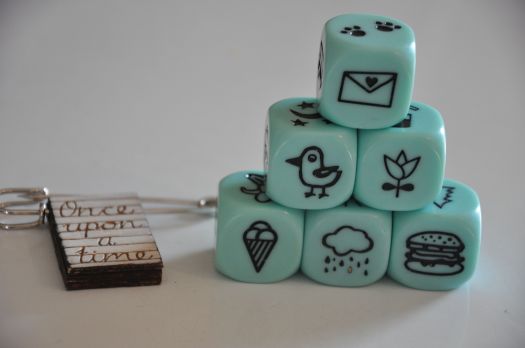
Whilst they’re not technically a book, they’re a great tool for encouraging story telling – either as a group or as a prompt for creative writing. The dice pictured above aren’t official ‘Story Cubes’, but the principal is certainly the same.

The child (or adult!) rolls the dice and has to come up with a story about the things they see. In the image above – for example – I might tell a tale about a duck, who had to deliver a letter through the pouring rain. He might shelter under a flower and notice that the envelope he held was starting to get wet. He feels terrible that he’s ruined the letter but on delivering it to his friend, he discovers that the sender had stuffed it full of ice cream which subsequently melted. To cheer the duck up, his friend takes him out for a burger. The end….

These have been brilliant for camping trips, long car journeys and waiting in restaurants – they take up next to no space in my bag and double up as blocks for stacking for younger children.

You can use them as a memory game (hide them under a napkin, turn the face of one over and have the kids try to figure out which block has been turned) or play “the first to throw a…” and assign a picture, taking it in turns to roll the dice until said picture emerges. My kids particularly enjoy, “the first to throw a duck” because of the images that conjures but there’s also a picture of a poop on one of the faces and that has also been an enormous success.

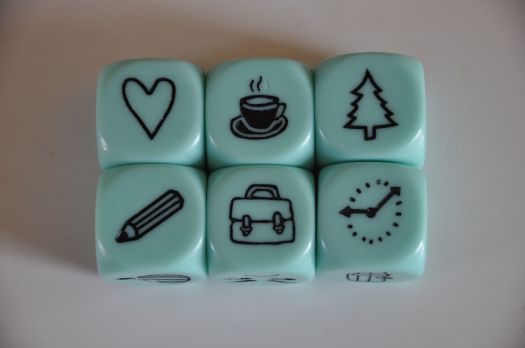
With a set of branded story cubes costing around £10, they’re not a cheap toy, but it’s easy enough to create something similar with different coloured dice. For example, by writing a key –
Red dice: 1 = bear, 2 = paint pot,  3 = chef’s hat, 4 = train, 5 = sad face, 6 = TV
Green dice: 1 = sea, 2 = viking hat, 3 = parcel, 4 = bus, 5 = scissors, 6 = arrows
Blue Dice: 1 = T-rex, 2 = bed, 3 = pizza, 4 = a magnifying glass, 5 = book, 6 = lips

Obviously these are just examples and you could do various lists to suit each child. You could also use some small, wooden blocks and add a sticker to each face which might be better for pre-readers.
At the moment, these are one of my favourite ‘wordy’ games, which is saying something, because I secretly really love i-spy (I know, I know…). Which are your favourite games which play with words? I’d love to hear them!

— Farn ❤

The Year at Maple Hill Farm by Alice and Martin Provensen

I first stumbled upon The Year at Maple Hill Farm by Alice and Martin Provensen by accident whilst rummaging through a pile of ‘3 for 99p’ books at our local charity shop. I picked it up solely to make up the numbers, but of the three I bought that day, this is the only one that’s still around.

At the time of writing this review (5/8/18), the book is out of print, but available second-hand in all the usual places you’d expect to find it. To my mind, it’s definitely worth going out of your way for.

The extract below pretty much sums up the book better than I could.

The twelve months each have a double-page spread, full of glorious illustrations which follow the inhabitants of Maple Hill Farm as they plant and harvest crops and work with livestock.

The book’s pace is sedate, but it isn’t lacking in humour. I really like the language – suitable for the very young but dry enough to leave me smiling.

And I love the artwork – I periodically toy with the idea of buying a second copy to cut up and hang on my walls.

This has been a favourite when my children have gone through phases of loving farm machinery and animals, and I usually bring it out again in the autumn (the season that speaks most of change to me). I use it to talk about where food comes from and about the months of the year – it’s a really rich book which covers many topics, making it ideal for home-ed libraries.

Which are your favourite books about the seasons? And where do you go to find your out-of-print books?

— Farn ❤

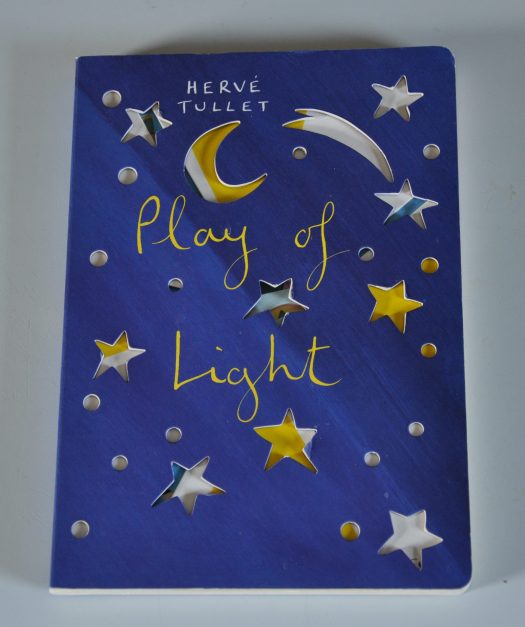
Play of Light by Herve Tullet

Play of light by Herve Tullet is, as the title suggests, all about play. The book itself contains few words and scant artwork but that isn’t where its charm lies.

I love a book that does more than you’d first think – fold-out artwork, flaps and magnifying glasses, coloured films which reveal other aspects of the pictures… it all really helps to make books and reading a properly magical experience.

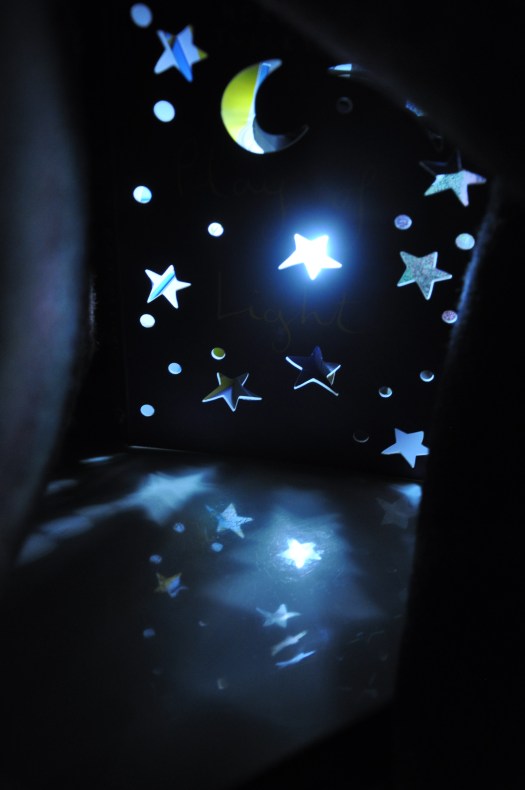
Now, you’ll have to take my word for it – because this book was essentially impossible for one woman with a camping lantern and a blanket to photograph – but when you hold it to the light, magical things happen!

I especially love the way that the waves shine on the surface that the book is stood on, making it feel like the ‘sea’ is bigger.

This is a wonderful book for very small children, because of the contrast between light and dark and the lack of complex text. It’s a great sensory experience, and as the child grows, can act as a starting point for discussions about how light works and how shadows are made.

Which are your favourite books which contain ‘a little extra’?

Farn ❤

Lots by Marc Martin & Maps; special edition by Aleksandra Mizielinska and Daniel Mizielinski

dsc_0215.jpg

dsc_0224.jpg

In addition to the lovely books we’ve been reading about migration, I also broke out these beauties – Lots by Marc Martin & Maps; Special Edition by Aleksandra Mizielinska and Daniel Mizielinski.

Lots definitely lives up to its name. It is, essentially, a picture book of many things, grouped by country.

DSC_0217

It’s safe to say that the artwork is the book’s main selling point, but although the words are sparse, they still manage to convey a wealth of humour and information. I particularly like the page about Japan, featuring Godzilla.

DSC_0221

The detail present is magical, and the artwork glorious.

DSC_0222

I love which details the artist has chosen to highlight from each place, like these pretzels from New York.

I also really like the fact that this book isn’t British-centric. In fact, we don’t even feature. It really is about the wider world and for me, that adds to the feel of adventure.

DSC_0219

Coupled with the special edition of Maps, these books are a fantastic introduction to geography.

The format of Maps isn’t that dissimilar; the pages are divided into countries, and some aspects of the nation’s culture are overlaid on the map in the form of small pictures.

DSC_0226

I really love the selection of things that are displayed in this book. Despite having studied Danish for four years and living in Denmark for two years, this spread still taught me new things about the country.

DSC_0229

I really love the detail in the illustrations, the colours, and the beautiful writing. As with Lots, I feel as though this book would have been far poorer for having been type-set. The hand-written look makes it feel almost as though you’re paging through someone’s sketch book – something that I really enjoy.

DSC_0228

Although both of these books are classed as children’s books, I would feel good about giving them to an adult friend who appreciated good art and travelling. And to me, that’s the mark of great children’s books – they appeal to everyone and bring generations closer together.

Which of your kids books are your favourites?

Farn ❤

We Travel So Far by Laura Knowles and Chris Madden & Wildlife: a map colouring book

Recently, we’ve enjoyed watching the swallows and house martens return to their nests around our eaves. There’s something about the construction of our cottage which seems to make it particularly inviting to these amazing birds and last year, we had over 30 nests by the end of the season. The skies outside have certainly become a lot busier and I wonder how many residents we’ll have by the time summer is out!

Coincidentally, We Travel So Far by Laura Knowles and Chris Madden arrived in our local library this week and gleefully we took it home to pair with our Wildlife maps colouring book.

As you can probably guess from the title, this book follows the migration journeys of various animals from around the world. Whether they’re going home to mate, or to spend winter in warmer climates, the book offers an insight into the lives of many incredible creatures that I’m guilty of taking for granted.

For example, I had no idea whatsoever that the humble monarch butterfly was a migratory creature!

The art work is absolutely beautiful – it’s bright and colourful, without being patronising, and accurate whilst maintaining its style.

Adding in the information from the maps colouring book, we were able to build up a pretty good idea of how far things had come in relation to existing journeys that we’ve taken – my kids know how long it takes for us to drive from Scotland to Denmark and we could look at that distance on the map and match it to those the animals had taken. We could also have a look at pictures of countries we know and see which animals we recognised from We Travel So Far.

One of the things I like most about this particular colouring book is that the pages are perforated and blank on the back. They’re ideal for hanging on the wall or on an easel. So often when I’ve coloured gorgeous pictures, I’ve thought about hanging them, only to decide against it on account of the fact I’d have to choose between sides.

Do you have any favourite books about the natural world?

Farn ❤