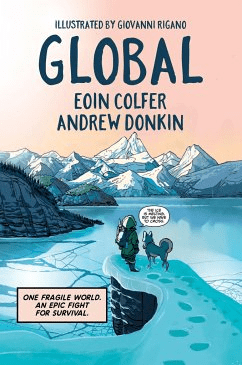
Global by Eoin Colfer, Andrew Donkin and Giovanni Rigano

Comics have had a lot of bad rep over the years, but hopefully as a society, we’re coming to recognise how important they are as a reading medium. Comics require reading skills, of course,* but they also require a visual literacy that translates wonderfully to the critical reading of advertisements. As someone who has always loved the medium, I’m really thrilled to see graphic storytelling being treated with increasing respect, and being employed for increasingly important topics.

This incredible graphic novel, Global, follows the lives of two children – one impacted by melting ice, the other by flooding land. Eoin Colfer, Andrew Donkin and Giovanni Rigano have done an absolutely amazing job of communicating the climate crisis in a personal, sympathetic, and beautiful way.

I found the afterword particularly affecting; throughout the book I felt as though I was reading about a point in the near-future, a time that was coming if we continue to do nothing. But the afterword made it clear that these were events were taking place in the present. The sheets explaining climate change following this were also fantastic, and really made the information accessible.

As someone who’s just coming out of a degree and so is used to citing everything, I also appreciated that this book had employed a research consultant (Vivien Francis). This is – sadly – not as common as you might think in non-fiction books, so to see it in a fictional work was particularly nice.

And for those, like my youngest, who might be concerned about the fate of the dog in this book, I’m happy to report that the dog is still alive at the end.

Overall, this is a fabulous book for humanising the climate crisis, and for engaging empathetically with the world around us. The two very different plots really help to bring home how multifaceted an issue this is, while still working within such a visual medium; comics don’t give you a lot of space for footnotes, or whole paragraphs dedicated to exposition, so this was such a clever way of exploring the interconnectedness of environments across the earth.

Of the various children’s books I’ve read which touch on climate change/the environment, this is by far the one I’ve liked best so far. If you’d like to investigate others, check out:
Terra Electrica (Middle Grade)
Feast of Ashes (Young Adult)
This Book is Not Rubbish (Non-fiction)
Plant the Tiny Seed (Picture Book)
We Travel So Far (Picture Book)
A Swift Return (Picture Book)

What are your favourite books about the environment and climate change for children? I would absolutely love some more recommendations!

Fran xxx

I’ve set up a ‘bookshop‘ of sorts, over on Bookshop.org, so that I can point you to somewhere to buy that isn’t Amazon. I get a small commission for any sales made there. This helps to support me running this blog. If you’d like to get your copy of Global this way, please just click here. Thank you for your support.

___
* If you’re not familiar with reading comics, I’d recommend conceptualising them as reading a play with images instead of stage-directions. And if you’re unfamiliar with plays, do yourself a huge favour and go and read The Importance of Being Earnest – it’s free on Project Gutenburg! It’s Oscar Wilde’s greatest gift to theatre kids the world over.

How to Be Disabled and Proud (or at least kinda sorta okay with it) – Cathy Reay

How to be Disabled and Proud by Cathy Reay was sent to us by the lovely Sally Oliphant for review and we have thoroughly enjoyed this.

It’s not something I tend to talk about often, but there’s a lot of neurodivergent people in my family – I’ve been diagnosed with autism and dyspraxia in recent years, and there are various other family members with their own things going on (though these aren’t my stories to tell).

That being the case, there were lots of excited, willing readers for this.

Let’s start with the intended demographic;

“I only read the part about puberty. It was really good. It was very inclusive and I liked the illustrations, they were eye catching and big, and had speech marks and stuff. And they finished the paragraph’s using a speech bubble.” – Youngest kiddo (10)

“It represented lots of different types of disabilities and it talked about intersectionality too, which was good. There were different sections for different types of disabilities like invisible and visible ones. It uses the author’s personal experience as well so it’s really authentic. I think it’s all explained in a really succinct way. I thought the illustrations were really cute and they’re so bright and lively that you can imagine them in colour, even though they’re black and white. They carried through the representation that was present in the text.” – Eldest kiddo (13)

For me, I wish I’d had this book growing up – which is something of a complicated statement, because I didn’t know about my own neurodivergence until much later. I think, though, that even if I’d found this book without knowing about my own disability, I’d have got so much from it. I knew I was different, even if I didn’t have words for why that was. I knew that I couldn’t do some of the things that the other children could, and the tone is such that even without possessing the vocabulary to describe my brain that I have now, I would have felt seen and valued.

For those interested, here’s the blurb:

A warm, funny and empowering guide to what you can expect growing up disabled, written by disabled journalist and mum Cathy Reay.

Have you ever felt like you don’t fit in anywhere?

Or like no-one understands what it feels like to be you?

Maybe you feel like you’re the only person in the world who looks, moves or thinks like you do.

Well, I’m here to tell you that you are not alone, and you belong in the world exactly as you are.

In this honest, funny, empowering guide, Cathy Reay draws on her own experiences of growing up disabled to encourage young readers to embrace (or at least, feel kinda sorta OK with) their disabled identity.

This book will guide disabled readers through navigating the move from primary to secondary school, voicing their accessibility needs, finding disabled community and gaining the confidence to stand up for their rights, and for others too. Cathy examines the challenges faced by disabled children, touching gently on issues such as bullying and discrimination, and what to do when people just don’t get it, with comforting and practical advice to help readers through tough times.

How To Be Disabled and Proud empowers disabled readers to value and appreciate themselves for who they are, exactly as they are, and acts as a powerful call to action for both disabled and non-disabled children to advocate for a more accessible, more understanding world.

Featuring interviews from a wide range of disabled changemakers and friends, including Ellie Simmonds, Jameisha Prescod, Nina Tame, Dr Shani Dhanda, Ellie Middleton, Elle McNicoll, Simon Wheatcroft and even a couple of disabled kids.

This is the essential guide to growing up disabled, perfect for children aged 9+ to read together with their families.

I’ve set up a ‘bookshop‘ of sorts, over on Bookshop.org, so that I can point you to somewhere to buy that isn’t Amazon. I get a small commission for any sales made there. This helps to support me running this blog. If you’d like to get your copy of How to be Disabled and Proud this way, please just click here. Thank you for your support.

The Nightmares of Finnegan Quick by Larry Hayes

The Nightmares of Finnegan Quick by Larry Hayes is a scary novel pitched at 11-13 year olds. We were lucky enough to get a review copy from the lovely Sally Oliphant, just before Christmas.

Both children – 10 year old and 13 year old – had a go at reading this, though (the admittedly very sensitive) 10 year old didn’t continue past the early pages. Youngest has a policy on not consuming media if the dog dies so…. that might be worth knowing if you have a similar stance.

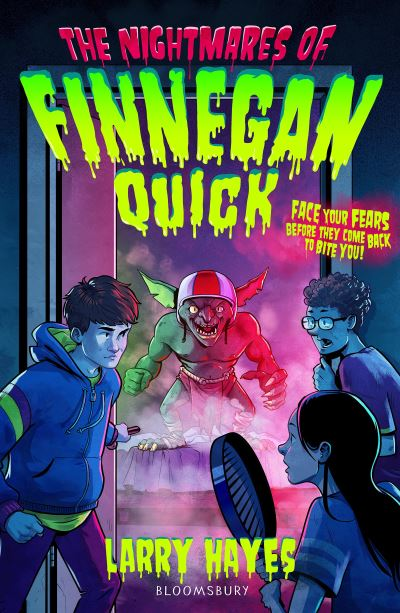
The story follows the eponymous Finnegan Quick, whose nightmares have an impact on the real world come morning. We went into reading this book expecting something akin to Goosebumps or Gremlins – given the excellent neon-nineties vibes of the cover – but the story itself was something darker, and there are some genuinely scary moments.

Eldest kiddo really enjoyed this book, and I think it’s the perfect sort of novel for those between years, when young adult books can be slightly too old, and middle-grade can feel slightly too young. Horror isn’t a genre that Eldest would usually read, but the more grown-up themes explored here within the context of a middle-grade novel worked perfectly. We’ll definitely be looking out for more books like this in future.

What are your favourite spooky books for children? Are there any you’d recommend we explore beyond the old-school obvious?

___

I’ve set up a ‘bookshop‘ of sorts, over on Bookshop.org, so that I can point you to somewhere to buy that isn’t Amazon. I get a small commission for any sales made there. This helps to support me running this blog. If you’d like to get your copy of The Nightmares of Finnegan Quick this way, please just click here. Thank you for your support.

Top 5 Books of 2024

With the year about to tick over into 2025, I thought I would take a moment to list my favourite five books of 2024 – in no particular order…

The Legendary Mo Seto by AY Chan was an absolute blast to read – I loved it, and so did all of my family.

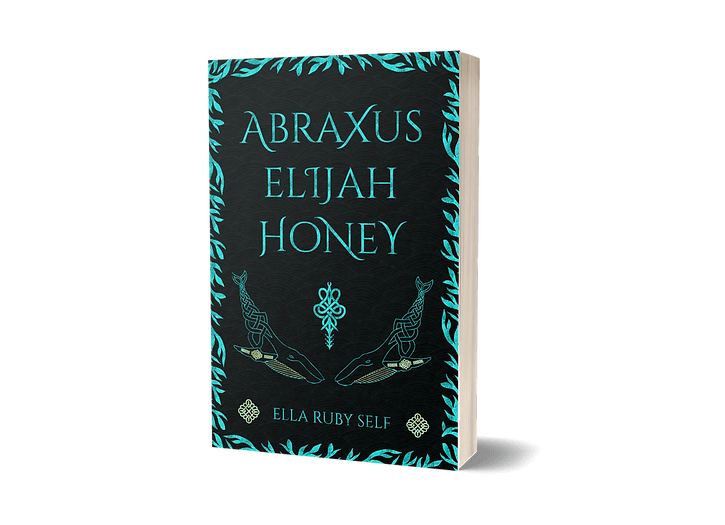
Abraxus Elijah Honey by Ella Ruby Self is probably my number one book of 2024. I haven’t actually got around to writing up a full review of it on here, but if you’re interested in my thoughts, check out my Storygraph

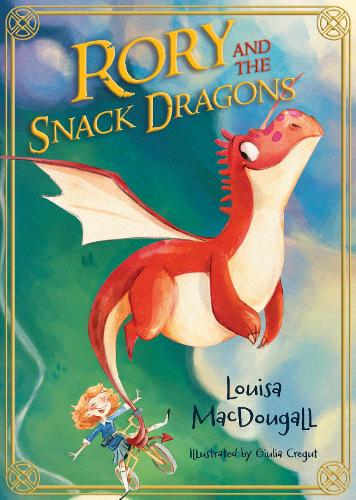
Rory and the Snack Dragons by Louisa MacDougall was a book my family had been waiting for since The Kelpies Prize 2022 when it was shortlisted. It absolutely didn’t disappoint, and despite both being older than the target demographic, both children absolutely loved this fantastically quirky, fun read.

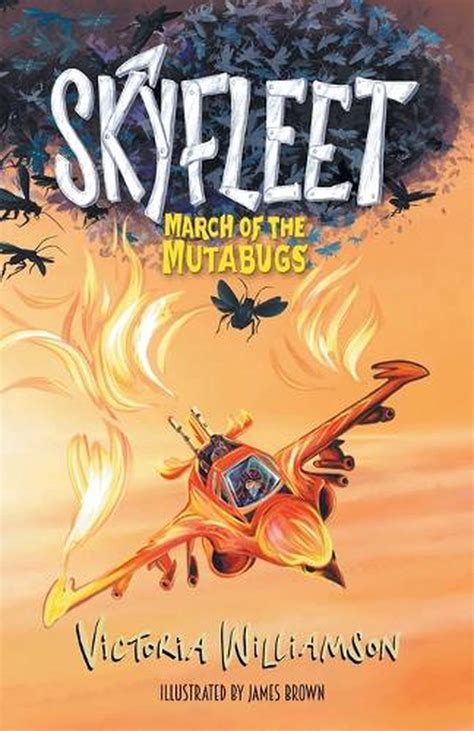
Skyfleet by Victoria Williamson was a super fun story which took me back to my favourite childhood cartoons in the best possible way.

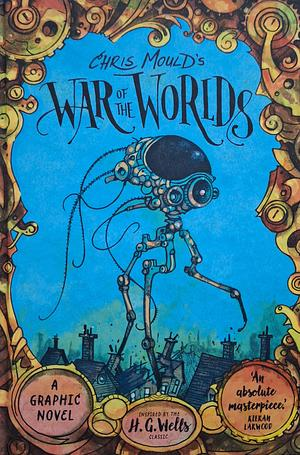
Chris Mould’s War of the Worlds Graphic Novel obviously had to feature. Again, I didn’t get a chance to write a dedicated review here yet, but what an absolute treat of a book. You can check out my thoughts on my Storygraph page.

Books that I really enjoyed that weren’t necessarily released in 2024, but that I read this year include:

Mexikid: A Graphic Memoir by Pedro Martín
The Secret Sunshine Project by Benjamin Dean
Pumpkin Heads A Graphic Novel by Rainbow Rowell
You Know, Sex: Bodies, Gender, Puberty, and Other Things by Fiona SmythCory Silverberg
Story of Now: Let’s Talk about the British Empire by Shelina Janmohamed

What are some of your favourite books from the last 12 months? What should I add to my (admittedly already vast) TBR pile for 2025?

Before signing off for 2024, I’d like to say a huge thank you to everyone who has sent me a book to review, or shared a link, or liked one of my posts. I really, really appreciate it.

2025 kicks off with some really exciting news for me, and I can’t wait to share it with you all.

I hope that whatever you’re doing this New Year, that it goes as well as it can for you.

See you on the other side.

xx

___

I’ve set up a ‘bookshop‘ of sorts, over on Bookshop.org, so that I can point you to somewhere to buy that isn’t Amazon. I get a small commission for any sales made there. This helps to support me running this blog. If you’d like to get your copy of the books mentioned above this way, please just click here. Thank you for your support.

Earth Hagiography by Sfarda L. Gül – LBT blog tour

Today, I’m reviewing Earth Hagiography, an adult poetry book by Sfarda L. Gül.

This is a first for me, and I’d love to know if you’re interested in me doing more.

But first, let’s get into this.

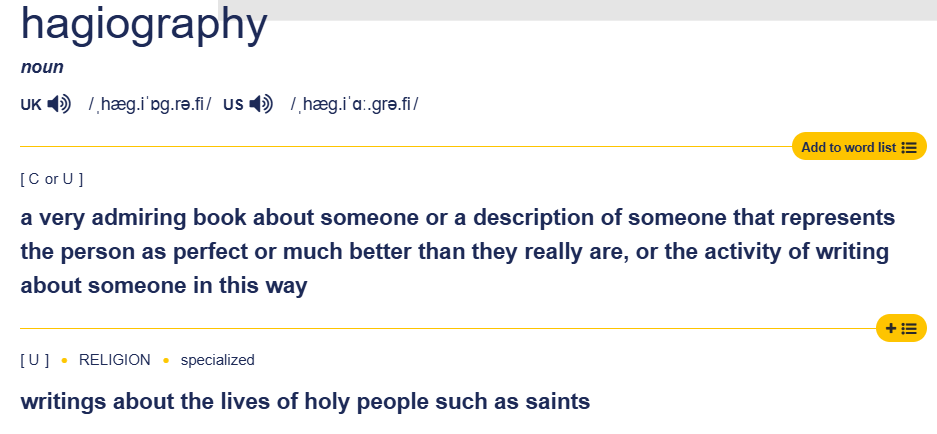
For those who don’t spend their lives reading about medieval saints for fun, a hagiography is – according to the Cambridge dictionary –

I love this as a title for a book of poems about the earth – it’s probably the main reason why I decided to review this book, rather than sticking to only children’s literature. Not only does it encapsulate this sense of a holy ‘Mother Earth’ , but it also speaks to the idea that we’re celebrating something that has passed – a warning, in this day and age, that the climate crisis can (and will) end us unless we act.

There’s very little in the way of introduction to this book, which I found to be something of a double-edged sword. I love poetry, but one of my favourite things about reading it is looking at the author’s intentions and the way that they were executed. I like Hollie McNish for this reason – her accompanying essays enrich the poetry so much – and I’ll forever be a fan of a good anthology, like Ella Risbridger’s Set Me on Fire. That said, it sort of works here – the intentions of the earth are unknowable, and we can only make meaning in the natural world for ourselves.

The poetry is enigmatic, and as a fan of writing that uses incredibly specific, unusual words that feel good to say aloud, I really loved the vocabulary of this book. And yes, I realise that sounds pretentious, but I was a linguist in a former life. I love the way we pronounce words in contrast to their spellings, and their etymologies, and the way that English has incredibly niche ways to describe such odd things. Words like ‘enubilous’ (used in Dew) just feel so good to say.

Time (Nonlinear) was a favourite – the branching penultimate and final verses reading like the splitting of tree roots. I also loved Taxidermy, which felt both grim and humorous and hopeful. I also found When I opened my Eyes and Natureless Sphericity to be particularly hard-hitting. And then there’s the layout of Solastalgia and Artificial Life both of which I could have spent a long time unpicking – and might, later.

Overall, the themes are somewhat bleak, but that’s probably because… *gesticulates wildly* You know. I do like that the final inclusion is a poem of hope though, or rather, a plea for something to hope for.

If you’re a fan of poetry and words, this is definitely a book you should consider.
___

So, what do we think? Should I review more adult books? More poetry books?

I would love to hear your thoughts.