
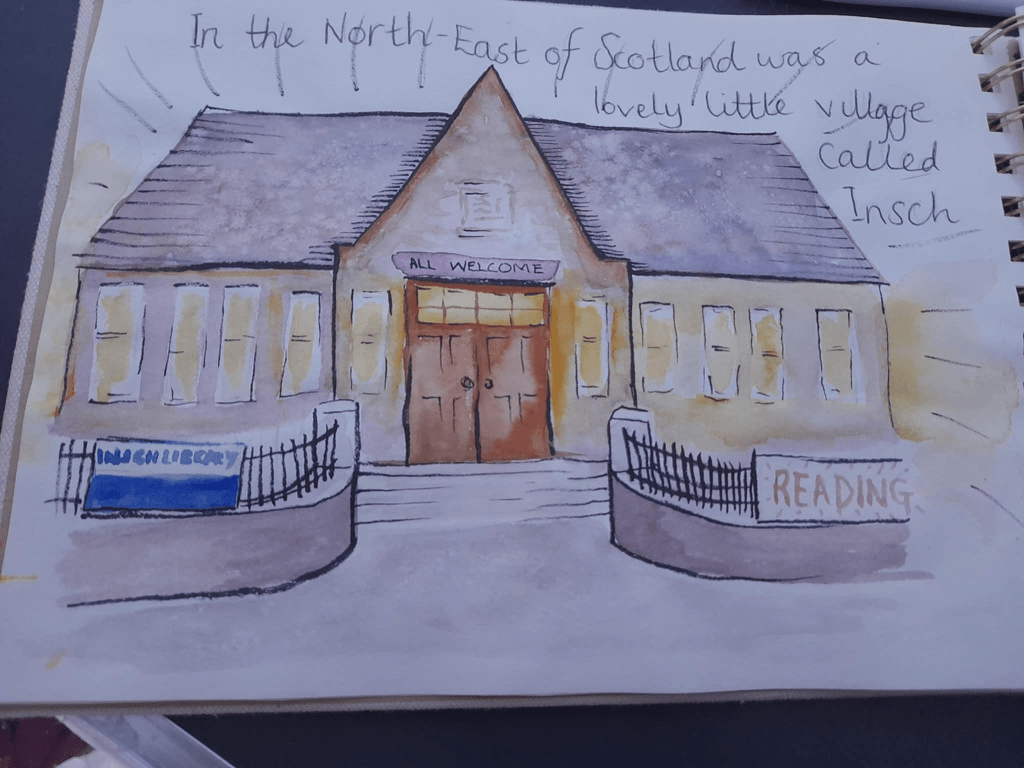
13 libraries across Aberdeenshire have been listed for closure. The following was written in support of Insch Library in particular, but the points made here are transferrable. I am in full support of all the impacted libraries remaining open. Please feel free to share with anyone who might find this useful. All sources are cited.
___
The library at Insch, and the other 12 facing closure across Aberdeenshire, directly contribute to a number of Aberdeenshire Council’s long term aims.
Noted in the statement regarding the closures from Aberdeenshire council is that libraries have been facing ‘declining numbers.’ I would be very keen to submit a FOI request on this, and would be paying close attention to whether these figures correspond with the fact that following lockdown, Insch library stopped opening on a Saturday. The weekend opening hours were admittedly limited, but given that this would be the only time that those in full-time employment could attend, I would venture that a reduction in times that are practical to the community are to blame, rather than a lack of community interest.
I’ve taken a look at the council’s own Culture Strategy and have flagged the following areas:
Page 5 Strategic Outcome 2
Our Sense of Place; A Place where communities will be stronger and more connected.
- We will use culture to tackle inequalities and promote diversity in our communities.
- We will develop opportunities for people to come together to share, learn and create.
- We will help close the gap in attainment through targeted interventions using culture.
Page 6 Strategic Outcome 4
Health and Wellbeing; A Place where lives are enriched and where people are happier and healthier
- We will encourage and promote learning and literacy.
- We will work with healthcare providers to support programmes which promote good mental health and improve life chances.
- We will use cultural activity to help older people live rich and independent lives for longer.
Closing the library at Insch will directly counteract all of these goals.
In terms of strategic outcome 2: Libraries tackle inequality by offering everyone the same access to learning resources. By providing a large range of books and other materials by a diverse range of authors, the library service promotes diversity. Libraries can also supply accessible materials, such as large print books. Library book clubs, Bookbug Sessions, Storytelling sessions, Craft Sessions etc. provide an opportunity for people to come together to share, learn and create. According to the Scottish Book Trust, for every £1 invested in library services, councils see a £5-7 return on investment, helping to close the gap in attainment through targeted interventions using culture.
Looking at Strategic Outcome 4: Libraries not only promote learning and literacy through making reading for pleasure attainable for families, regardless of income, but they also support schools – such as Insch and Kennethmont Primary – which lack the space for a dedicated library service on site. Again, returning to information from the Scottish Book Trust, libraries help to improve mental health by alleviating social isolation.* According to Alzheimer’s Research UK, reading may help delay the onset of dementia by up to 5 years, representing less of a demand on the social care system. According to the Alzheimer’s Society, loneliness can also increase the risk of dementia, making libraries as a social hub vital for ensuring people can live independently for as long as possible.
Moving onto Aberdeenshire Council’s own Resources and Circular Economy Commitment:
This document states that the council will “promote, effect and support circular economy principles and practice internally and in our external areas of influence.” The library is the perfect example of a circular economy model – we should be striving to expand library services, rather than curtail them. The document does, in fact, go on to state this too, adding that the council will “establish reuse systems and processes that facilitate the efficient and effective internal sharing and reuse of all manner of council physical resources.” This can be achieved by the distribution of books – and potentially other materials – through local libraries.
Furthermore, the closing of Insch library will necessitate an increase in travel, from the village to either Huntly or Inverurie. Some residents will be unable to make this journey due to the cost of public transport or limited access to cars. Aside from directly contradicting Strategic Outcome 2’s aim to ‘tackle inequalities’, for those able to access other libraries, it will add a further 6kg of CO2 to the atmosphere per return trip in an average petrol or diesel vehicle between Insch and Inverurie.** Depending on how often families choose to make the additional trip to Inverurie to access the library there, this could result in an approximate increase of 252kg of CO2 per household (based on the above vehicles, and service users visiting the library roughly 42 times per year).
In simple terms;
Libraries are vital for free entertainment – a book can be enjoyed for free, or at most, the cost of a lightbulb being on for a few hours. As the cost-of-living crisis worsens through the winter, even Insch library – with its spartan opening times – can provide a small window of warmth for people struggling to heat their homes, as well as something to do in an evening. This can help bolster peoples’ mental health.
In a library, everyone is equal. Access to content isn’t gated according to income. Libraries are levellers of education, allowing children from less affluent backgrounds the same access to resources as those from wealthier homes.
Libraries are a safe space, particularly in rural communities. After school, young people have increasingly few places to go during the winter. As it becomes too cold for parks, libraries can provide a space for people to escape to if things aren’t quite right at home. Library internet access and PCs also make it possible for those whose communications might be monitored at home to reach out for help. Insch library provides free sanitary protection, helping to combat period poverty.
Librarians are lifelines for the lonely. They offer Bookbug sessions to new parents, creating a network of families and friends that might last a lifetime. They are sometimes the only contact an elderly person has with another human being throughout the week. Again, none of this is income dependent. Even if someone can’t afford to nip to the corner shop for a paper and a chat with the cashier, they can afford to pop into the library for a browse and a chat. Book clubs provide further opportunities to strengthen our communities – something we need now more than ever in our current age of division.
Libraries offer credibility. In a time of misinformation proliferated online with no more than a click, libraries provide a wealth of knowledge that has been through fact-checkers and editors, proofreaders and publishers. For people interested in fighting misinformation, libraries can arm them with facts.
Libraries can help to fight the climate crisis. In addition to offering entertainment that needs no electricity or delivery, libraries are the original resource-sharing hub. Not only do many people share fewer books, but by having a library in Insch instead of forcing people to travel to Inverurie or Huntly to get their reading material, we keep emissions down. By decentralising resources, we ensure that access to a car isn’t a prerequisite for access to learning.
Libraries provide accessible material. Large print books and audio books make literature more readily available to everyone.
From a personal perspective, the library at Insch has been a lifeline for me. I have two children who devour books at a rate that I can’t afford to provide myself. Between 2014 and 2022 my eldest child has borrowed 676 books/playaways (according to Spydus), whilst my youngest child borrowed 596. I loaned 276. That’s 1548 books/audiobooks in total.
In 2023, I borrowed 44 books from the library. Out of curiosity, I added up how much this would have cost me via amazon; it came to just over £400.
In 2024, so far, my eldest child has borrowed 60+ novels, whilst my youngest has checked out a whopping 110 books – mostly expensive comics! So that’s at least another £400+ per child and over £1200 of value brought to the community for our little trio of readers.
I’d love to know how many families are registered at Insch library – it would be amazing to look at these numbers on a larger scale.
*NB: I have linked to Social Media images, rather than the studies cited in said images for ease of data-reading. More in-depth information can be found here: https://www.cilip.org.uk/news/599345/Report-Public-Libraries-The-Case-for-Support.htm
**Calculations done via the Michelin website.
 THE INQUISITIVE NEWT