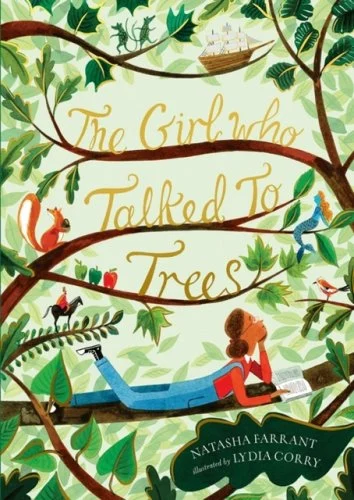
The Girl Who Talked to Trees by by Natasha Farrant and Lydia Corry 

This is a gorgeous concept-album of a book. Following the story of Olive, The Girl Who Talked to Trees by by Natasha Farrant and Lydia Corry, is about the life of an oak across the ages, but also about the other trees close by.

When ‘her’ oak is threatened with removal, Olive sends out a wish, hoping to figure out how to save it. In her dreams, the trees begin to tell her tales of their lives across time – a series of self-contained, yet interconnected short stories which cover the mythology and facts about different types of trees. On waking, Olive uses these tales to advocate for her oak, and ultimately save it.

The connection between people and the natural world is beautifully explored in this book, not just in the present day, but also across history. The differences between how people treat some kinds of tree compared to others is also touched upon, as is the way we conceptualise the forest, verses individual trees.

I actually listened to this as an audiobook, so wasn’t aware how beautifully illustrated the physical copy is. Researching for this post, though, led me to some photos of amazing full colour illustrated spreads, and I think I might have to invest in my own copy. It was amazing to listen to this book, but I’d like to be able to enjoy the glorious artwork too.

This is a rare look at the very personal side of felling trees, and the way in which individuals interact and form relationships with single plants. It reminds me of a line from Oak and Ash and Thorn, by Peter Fiennes where he asserts that whilst Britain loves trees, we’re afraid of the woods. That really plays out here, across the series of short stories.

If you’d like more books on nature, the environment, plants, or the climate crisis, there’s a short list here. Hopefully I’ve included something for everyone:

Terra Electrica (Middle Grade)
Global (Graphic Novel)
Feast of Ashes (Young Adult)
This Book is Not Rubbish (Non-fiction)
Ruby Nettleship and the Ice Lolly Adventure (Picture Book)
Plant the Tiny Seed (Picture Book)
We Travel So Far (Picture Book)
A Swift Return (Picture Book)

What are your favourite nature books for children? Do you know of any others told in this short-story format? As always, I would love to hear your recommendations! ❤

Fran xx

___

I’ve set up a ‘bookshop‘ of sorts, over on Bookshop.org, so that I can point you to somewhere to buy that isn’t Amazon. I get a small commission for any sales made there. This helps to support me running this blog. If you’d like to get your copy of The Girl Who Talked to Trees this way, please just click here. Thank you for your support.

Tyger by SF Said and Dave McKean

Before I start reviewing this book, I’d like to tell you a short story about our local landscape.

In the 1800s, pushed from their homes by the Improvement practices that estates were bringing into force at this time, a group of crofters set up home on the Commonty (or common land) of Bennachie. This so-called ‘squatters settlement’ lasted for around 50 years before three lairds decided that the inhabitants had made this land fertile enough to be useful, at which point, said lairds made to claim it. In celebration of their success, they capped the hill with a carved stone – something that we know to this day as ‘the thieves’ mark’.

A photo I took of the “Thieves Mark”. This is carved into the bedrock on top of Bennachie’s peak, Mither Tap . The “B” stands for Balquhain, the “P” for Pittodrie, and the “LE” for Logie Elphinstone. The stone is dated 1858 although the Court of Session didn’t approve the sectioning of the land until 1859. Bit cocky.

You can read more about their story here.

So why am I telling you this?

Tyger by SF Said follows the story of Adam – a young immigrant boy living in a British Empire London. Adam discovers a mystical tyger, hiding in a rubbish dump and pledges to help said tyger face an encroaching danger which threatens its life. Using his talent for art, and through speaking to people across various echelons of this eerily familiar Empiric Britain, Adam and his friend Zadie aim to avert disaster.

Again – what’s with the story about the commons?

The theft of common land by the powerful is a large theme of Said’s book, and it stuck with me on account of my ties to the Bennachie colony. Not only do I live within drivable distance, I’ve also helped out on digs close to this site, and researched the history of the place for my archaeology degree. A combination of the local past and the empathy I felt for Said’s characters really stirred something deep inside me as I read this, and I found myself with a bubbling anger at what had been done to the Bennachie ‘squatters’. When I tried to express this rage at the theft of common land to friends, I was met with blank stares. So few people now understand that there used to be swathes of countryside set apart for people to use as they needed – whether for grazing livestock, or gathering stone, or in the case of Bennachie, for living on when rents became impossible. The violence of the abolition of common land could be seen in the archaeology of this settlement – crockery lay smashed, just beneath the surface from where residents had been dragged from their homes for refusing to pay rent. To quote from the link above;  it is believed that a sheriff’s officer, policeman, factor, and estate employees would pull down a course of masonry so that the wall [of residents’ houses] would collapse.

This isn’t something that took place within the distant past – these are events from our great-grandparents’ living memory. The theft of the commons is something that shapes our daily lives now. I love how Tyger brings this part of our history into focus, and can open discussions about land ownership, right-to-roam, and trespass. The need for connection between people and the earth matters now more than ever, and without space in which to foster that connection – space which is accessible to all and doesn’t depend on income – is absolutely vital.

And then there’s the elements of the book which tackle the concepts of national identity, the role of the outsider, the desire to conform…. honestly, there are dissertations-worth of things I could say about this book and how important it is that young people read it. Colonialism impacts all aspects of our lives, and it’s crucial that we understand that so we can take steps to counter it.

I’m going to be reviewing a book about the history of the British Empire soon – Story of Now – but as I think it goes hand-in-hand with Tyger, I thought I would mention it here. These books in combination would make for an incredible addition to anyone teaching the Victorians. Before, or while reading it, I highly recommend looking up where your local common land used to be, or just looking up the Cambridge Cows.

Can you think of any other books which deal with common land and the theft of it? Do you know of any other good books for children, about the harms of the British Empire? I would love to hear your thoughts.

— Fran xxx

I’ve set up a ‘bookshop‘ of sorts, over on Bookshop.org, so that I can point you to somewhere to buy that isn’t Amazon. I get a small commission for any sales made there. This helps to support me running this blog. If you’d like to get your copy of Tyger this way, please just click here. Thank you for your support.
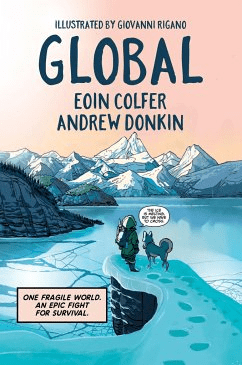
Global by Eoin Colfer, Andrew Donkin and Giovanni Rigano

Comics have had a lot of bad rep over the years, but hopefully as a society, we’re coming to recognise how important they are as a reading medium. Comics require reading skills, of course,* but they also require a visual literacy that translates wonderfully to the critical reading of advertisements. As someone who has always loved the medium, I’m really thrilled to see graphic storytelling being treated with increasing respect, and being employed for increasingly important topics.

This incredible graphic novel, Global, follows the lives of two children – one impacted by melting ice, the other by flooding land. Eoin Colfer, Andrew Donkin and Giovanni Rigano have done an absolutely amazing job of communicating the climate crisis in a personal, sympathetic, and beautiful way.

I found the afterword particularly affecting; throughout the book I felt as though I was reading about a point in the near-future, a time that was coming if we continue to do nothing. But the afterword made it clear that these were events were taking place in the present. The sheets explaining climate change following this were also fantastic, and really made the information accessible.

As someone who’s just coming out of a degree and so is used to citing everything, I also appreciated that this book had employed a research consultant (Vivien Francis). This is – sadly – not as common as you might think in non-fiction books, so to see it in a fictional work was particularly nice.

And for those, like my youngest, who might be concerned about the fate of the dog in this book, I’m happy to report that the dog is still alive at the end.

Overall, this is a fabulous book for humanising the climate crisis, and for engaging empathetically with the world around us. The two very different plots really help to bring home how multifaceted an issue this is, while still working within such a visual medium; comics don’t give you a lot of space for footnotes, or whole paragraphs dedicated to exposition, so this was such a clever way of exploring the interconnectedness of environments across the earth.

Of the various children’s books I’ve read which touch on climate change/the environment, this is by far the one I’ve liked best so far. If you’d like to investigate others, check out:
Terra Electrica (Middle Grade)
Feast of Ashes (Young Adult)
This Book is Not Rubbish (Non-fiction)
Plant the Tiny Seed (Picture Book)
We Travel So Far (Picture Book)
A Swift Return (Picture Book)

What are your favourite books about the environment and climate change for children? I would absolutely love some more recommendations!

Fran xxx

I’ve set up a ‘bookshop‘ of sorts, over on Bookshop.org, so that I can point you to somewhere to buy that isn’t Amazon. I get a small commission for any sales made there. This helps to support me running this blog. If you’d like to get your copy of Global this way, please just click here. Thank you for your support.

___
* If you’re not familiar with reading comics, I’d recommend conceptualising them as reading a play with images instead of stage-directions. And if you’re unfamiliar with plays, do yourself a huge favour and go and read The Importance of Being Earnest – it’s free on Project Gutenburg! It’s Oscar Wilde’s greatest gift to theatre kids the world over.

The Remembering by Dione Orrom – Random Things Blog Tour

There’s a lot to talk about when it comes to The Remembering by Dione Orrom, and honestly, I’m not really sure where to start.

Simply put, this book is a journey through a dying landscape, in a last-ditch attempt at saving the world from the environmental mistakes of humanity. There were shades of The Neverending Story to this – a race through a collapsing world which emphasises the beauty of things through their absence. There’s also what feels like a nod to The Lion, The Witch, and the Wardrobe – a collection of disparate animals coming together to fight against dark forces. There’s so much to like about this book and so much that makes it timely.

But let’s start at the beginning which – honestly? – is going to put some people off. So, while I’m saying this, please keep in mind that I loved the rest of the book. Really, actually loved it. The thing is though, the first three chapters are… slow. And in chapter 2, especially, there’s a lot of exposition through conversation. That’s not necessarily a bad thing, but when the rest of the book is so fluid and pacy, it felt jarringly clunky. Youngest child (9) gave up, and Eldest (13) said it was a close call.

I think this is partially down to how rich the lore of Orrom’s world is – how much there is to say about every aspect of what’s going on. As the story continues, the quick pace and sense of urgency makes the book very difficult to put down. I read a digital copy, and though the first 20 pages or so were difficult to get through, I found myself at 72% finished by the point it was so far Past My Bedtime that I had to stop reading. I finished the rest first thing the following morning.

As I said above, this story pulls together lots of elements from classic children’s literature. In addition to The Neverending Story, and C.S. Lewis’s cornerstone of children’s fantasy, I could see shades of Michelle Paver’s Wolf Brother series in the characters of Snakeskin and Aster. There are echoes of Elidor in the way that the children only ever know part of what’s going on – there’s the sense that they’re minor characters in a much larger adventure. Some of these books, are amongst my all time favourites.

I think though, as a keen forager, that what I loved most about The Remembering was the way that time-travel seemed to work through the mitochondrial root network that connects tress to fungi. I thought this was absolutely genius and loved the way that Orrom continued this tree-inspired lore throughout. I loved that the trees of the council each had their own personalities and roles to play. Honestly, chef’s kiss to all the lore of this world.

I spoke a little while ago about dystopian climate fiction and how I don’t think it’s the way to engage people with the realities of climate crisis. I passionately believe that we need a future to fight for, more than we need one to steer from. Though it’s never explicitly stated whether Snakeskin and Aster exist in the past or the future of Jack’s time, the closeness that they share with the natural world is something that we can all aim for. Perhaps not literally speaking to the trees – though you never know – but by engaging with the world as a part of it, rather than master of it.

To sum up – if you’re reading this as an adult, stick with it past the first few chapters – you won’t be disappointed. If you’re reading this with children, perhaps read the first five chapters or so together, before handing the book across*.

What are your favourite climate fiction books? I’d love to read some – especially those which offer a vision of hope, rather than dystopia.

___

*This works for Youngest child. Sometimes they’re** convinced that a book with smaller writing is ‘too hard’ so we read the first few chapters together (take a page, turn about), and by the time we get to chapter 2 or 3, kiddo is ready to read the rest alone.

**I’m using the singular ‘they’ pronoun for anonymity, rather than gender reasons, though if you do have recommendations on books for non-binary children, I’d love to hear them.

___

I’ve set up a ‘bookshop‘ of sorts, over on Bookshop.org, so that I can point you to somewhere to buy that isn’t Amazon. I get a small commission for any sales made there. This helps to support me running this blog. If you’d like to get your copy of The Remembering this way, please just click here. Thank you for your support.

This Book is Not Rubbish by Isabel Thomas

After Daughter’s enthusiasm for Kids Fight Plastic by Martin Dorey, we thought we would have a look at This Book is Not Rubbish by Isabel Thomas.

Very similar to the previous title, this book details child-friendly ways to reduce our impact on the environment.

Firstly, as an adult reading this (and especially as an adult being expected to miraculously implement everything right now) I would have liked a link to the science that backs the claims of this book. I kept trying to find sources for the facts and figures stated, but kept coming up blank. I felt that some of the points contradicted what’s often accepted as common environmental wisdom but that’s possibly because I haven’t read enough recent literature on the subject.

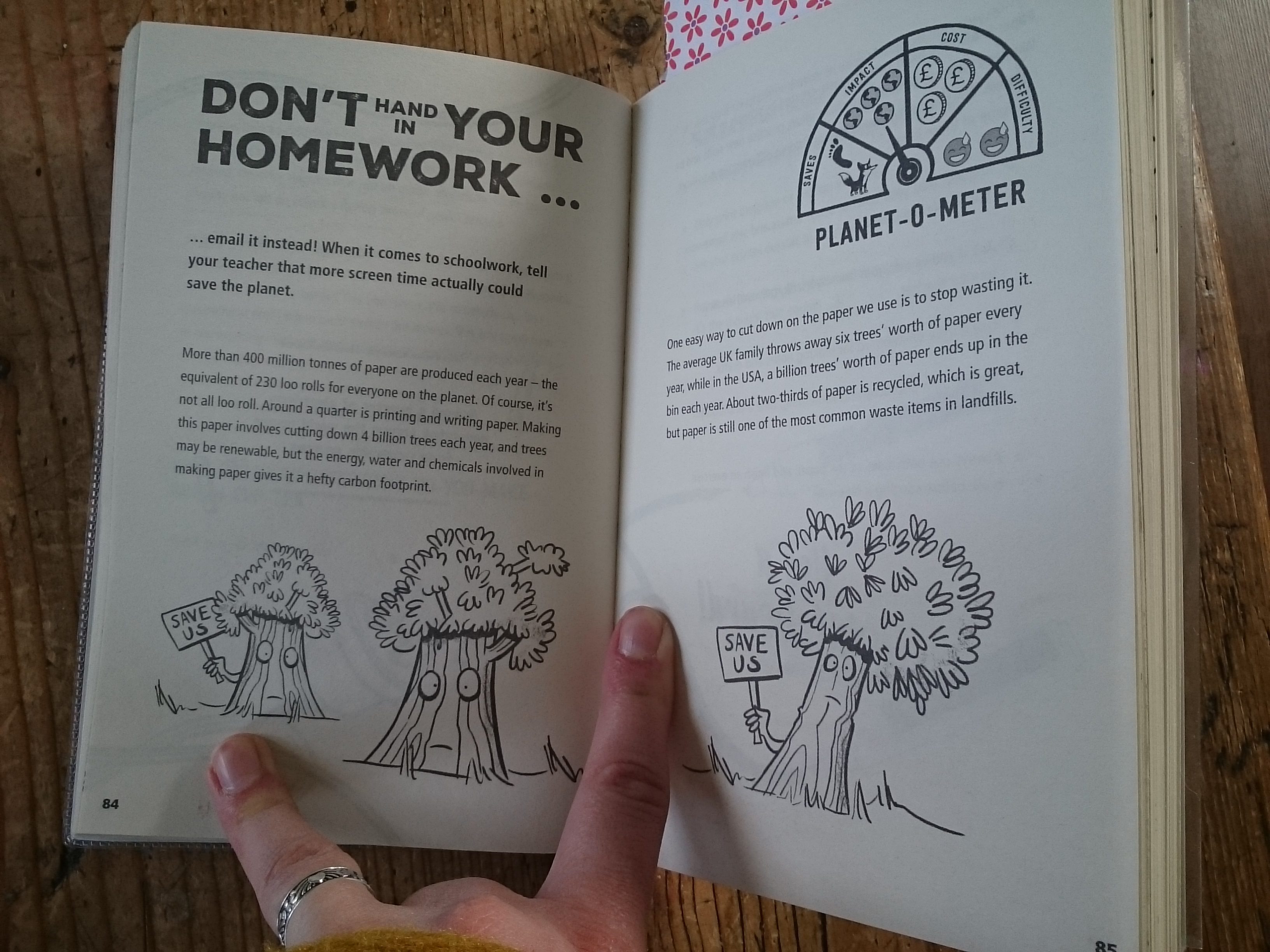
That aside – again, as an adult – I felt that the illustrations and jokes were trying a little too hard to appeal to children. Daughter actually got fairly upset at the thought of sentient trees (pictured above) and would have just preferred a wholly factual approach as in the previous book. That said, we are a fairly atypical family in many respects, so perhaps this approach would work for those who found Kids Fight Plastic too blunt.

Regardless of these comments, I would definitely recommend this title for any small ecologists. The almost bullet-point nature makes it accessible to reluctant readers, or makes it a really quick read for those who are more confident. It’s also nice to have something to dip in and out of – ideal to read during short journeys, or to keep on a living room table for a quick ‘grab’ from bored little fingers.

We’ve got one earth-friendly book to review fromm our reading so far. Are there any similar books you would recommend?

Farn ❤