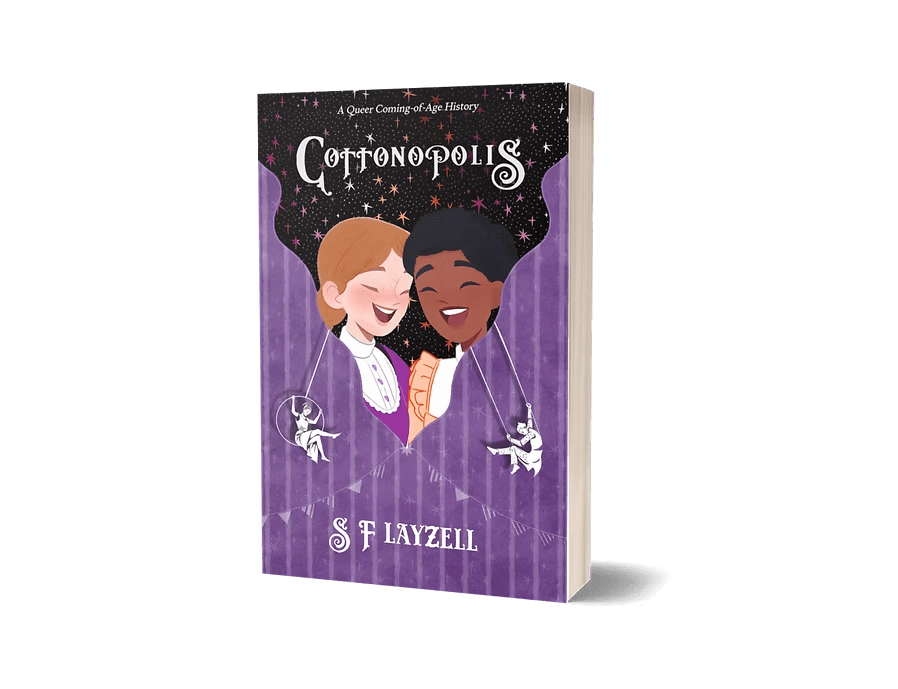
Cottonopolis by SF Layzell


A few weeks back, I took part in a Northodox Pride Party author panel, chaired by the lovely SF Layzell – which was absolutely brilliant for so many reasons. Not only did I get to chat to some other great authors, but I also got to hear about Layzell’s book, Cottonopolis. AND I was lucky enough to get an extract to post here!!

Recently longlisted for the Little Rebels Children’s Book Award 2025, Cottonopolis is a story of family, friendship and first love, with a twist of magic, set in Victorian Manchester. It’s the story of Irish mill girl Nellie Doyle, who works hard to take care of her little brothers, and her growing friendship with Chloe Valentine, who is in search of a better life away from Manchester’s notorious workhouse.

In the extract below, Nellie and Chloe meet for the first time. Both have stepped away from their work, enticed by the sight and smells of a new bakery stacked high with goods neither of them can afford.


I follow the pickpocketing boy through the crowd, hoping to see the bakery for myself. What does the best bread look like? It must be something to bring such a crowd.

A shiver runs through me as the bakery door swings open and a sweet, full smell drifts out. It’s heaven. I can taste it!

I feel like I can almost reach out and grab a handful of it to take home in my pocket. Just imagine the boys’ faces, if I could reach into my pocket and pull out a fistful of this smell, shining like gold, and let my fingers ease apart ever so slightly to let just a little of it out, unfurling and filling their little nostrils.

I’m pressed forward by a sudden rush of people and part of me finds a little pleasure in knowing that some of them will find their purses lighter than they expected when they come to pay. People leaving the shop push in the opposite direction to the rest of the crowd, making me feel like a pebble lost deep in the swirling sludge of the Medlock. As they pass, I get a faint whiff of the sweet smelling delights every one of them carries, wrapped up in tiny individual boxes, each tied with a thin black velvet ribbon.

After what seems like an age (and I’m sure I’m going to be in trouble when I get back, though I can’t seem to pull myself away), I reach the big shop window. The window is a wonder in itself, a smooth clean sheet of glass. A sea of breads and cakes spreads out before me, stretched and cut and moulded into beautiful shapes. There are sticky round buns coated in syrup and dusted with spices, plaits of flaky pastry sprinkled with tiny white nuts and purple flowers made out of sugar, and cut-out golden discs layered with firm custard, fresh red fruits and dollops of yellow cream.

‘Makes you sick, doesn’t it,’ a tight angry voice rings out beside me. I jump back from the window, the spell broken, and find myself staring into the face of a girl about my age. The way she speaks is sharp and quick but full of feeling. English. Like the pickpocket boy. That’s where the similarities end though.


____

Sounds brilliant, right? Here’s the blurb, in case you want any more information….

Welcome to 1840s ManchesterTwelve-year-old mill girl NELLIE DOYLE faces eviction and starvation when her father loses his job. But growing up in the notorious Manchester slum of Little Ireland has made her plucky. She befriends CHLOE VALENTINE and has a chance meeting with a circus owner who seemingly grants seven wishes. They embark on a journey to improve their circumstances. Amidst wishes for peace, freedom, and family reunion, Nellie realizes her growing feelings for Chloe, learning that magic doesn’t always work as expected, and sometimes, you must create your own.

Aaaand, here’s some more details about the Little Rebels awards:

I’m waiting for pay day, and then I’m going to grab myself a copy to review. I just wanted to highlight this book as part of the many amazing LGBTQIA+ books that I’m showcasing this June.

___

I’ve set up a ‘bookshop‘ of sorts, over on Bookshop.org, so that I can point you to somewhere to buy that isn’t Amazon. I get a small commission for any sales made there. This helps to support me running this blog.

If you’d like to get your copy of Cottonopolis, please just click here to support the publisher, or to buy from the bookshop Queer Lit. If you’d like to support me without buying a book, you can do so here. Thank you.

DISCLOSURE: My own book – When The Giants Passed Through – will also be published by Northodox Press.
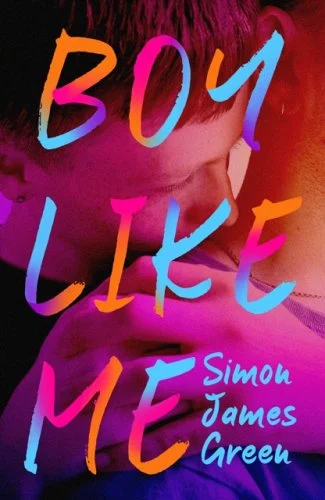
Boy Like Me by Simon James Green

Boy Like Me by Simon James Green is honestly one of the books I remember best from 2023. The narration is sharp and witty, the romance is tender and sweet, and the cutting comments about Section 28 were deeply appreciated by my little 80s-child heart.

Boy Like Me follows Jamie (not that Jamie, or this James) through his final year of secondary school in 1994. With book bans common-place under the rules of Section 28, a kind librarian sneaks Jamie a novel which helps him to make sense of how he’s feeling, and through notes in the margins, helps him to connect with another Boy Like Him (see what I did there? 😉 )

This book is a fantastic YA offering which not only provides a deeply satisfying romance, but also explores life at a time when it was effectively illegal to speak about homosexuality in British schools. It’s something that I feel is more important now than ever, with the UK creating an increasingly hostile environment for the trans community. Looking back at the arguments made for Section 28, it’s clear to see where a lot of the anti-trans rhetoric is coming from; we’ve been here before. Equipping young people with the tools they need to see through this is essential, and Boy Like Me is a great way to open these conversations if you’ve not had them before.

As an adult reading this book, I really appreciated the 90s nostalgia, so if you’ve got older children who are past the point of being read to, this is a great book to read alongside them and discuss. When Eldest kiddo stopped asking for me to read, I found that being able to enjoy the same novels was a key way to stay connected through stories, and this one was a genuine joy.

What books would you recommend to teen readers? Are there any YA books you’ve read along with older children, and if so what are they?

___

I’ve set up a ‘bookshop‘ of sorts, over on Bookshop.org, so that I can point you to somewhere to buy that isn’t Amazon. I get a small commission for any sales made there. This helps to support me running this blog. If you’d like to get your copy of Boy Like Me this way, please just click here. If you’d like to support me without buying a book, you can do so here. Thank you.

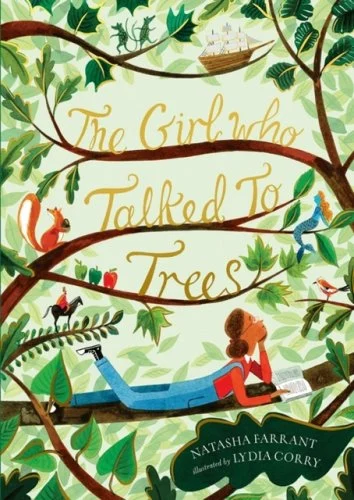
The Girl Who Talked to Trees by by Natasha Farrant and Lydia Corry 

This is a gorgeous concept-album of a book. Following the story of Olive, The Girl Who Talked to Trees by by Natasha Farrant and Lydia Corry, is about the life of an oak across the ages, but also about the other trees close by.

When ‘her’ oak is threatened with removal, Olive sends out a wish, hoping to figure out how to save it. In her dreams, the trees begin to tell her tales of their lives across time – a series of self-contained, yet interconnected short stories which cover the mythology and facts about different types of trees. On waking, Olive uses these tales to advocate for her oak, and ultimately save it.

The connection between people and the natural world is beautifully explored in this book, not just in the present day, but also across history. The differences between how people treat some kinds of tree compared to others is also touched upon, as is the way we conceptualise the forest, verses individual trees.

I actually listened to this as an audiobook, so wasn’t aware how beautifully illustrated the physical copy is. Researching for this post, though, led me to some photos of amazing full colour illustrated spreads, and I think I might have to invest in my own copy. It was amazing to listen to this book, but I’d like to be able to enjoy the glorious artwork too.

This is a rare look at the very personal side of felling trees, and the way in which individuals interact and form relationships with single plants. It reminds me of a line from Oak and Ash and Thorn, by Peter Fiennes where he asserts that whilst Britain loves trees, we’re afraid of the woods. That really plays out here, across the series of short stories.

If you’d like more books on nature, the environment, plants, or the climate crisis, there’s a short list here. Hopefully I’ve included something for everyone:

Terra Electrica (Middle Grade)
Global (Graphic Novel)
Feast of Ashes (Young Adult)
This Book is Not Rubbish (Non-fiction)
Ruby Nettleship and the Ice Lolly Adventure (Picture Book)
Plant the Tiny Seed (Picture Book)
We Travel So Far (Picture Book)
A Swift Return (Picture Book)

What are your favourite nature books for children? Do you know of any others told in this short-story format? As always, I would love to hear your recommendations! ❤

Fran xx

___

I’ve set up a ‘bookshop‘ of sorts, over on Bookshop.org, so that I can point you to somewhere to buy that isn’t Amazon. I get a small commission for any sales made there. This helps to support me running this blog. If you’d like to get your copy of The Girl Who Talked to Trees this way, please just click here. Thank you for your support.

Tyger by SF Said and Dave McKean

Before I start reviewing this book, I’d like to tell you a short story about our local landscape.

In the 1800s, pushed from their homes by the Improvement practices that estates were bringing into force at this time, a group of crofters set up home on the Commonty (or common land) of Bennachie. This so-called ‘squatters settlement’ lasted for around 50 years before three lairds decided that the inhabitants had made this land fertile enough to be useful, at which point, said lairds made to claim it. In celebration of their success, they capped the hill with a carved stone – something that we know to this day as ‘the thieves’ mark’.

A photo I took of the “Thieves Mark”. This is carved into the bedrock on top of Bennachie’s peak, Mither Tap . The “B” stands for Balquhain, the “P” for Pittodrie, and the “LE” for Logie Elphinstone. The stone is dated 1858 although the Court of Session didn’t approve the sectioning of the land until 1859. Bit cocky.

You can read more about their story here.

So why am I telling you this?

Tyger by SF Said follows the story of Adam – a young immigrant boy living in a British Empire London. Adam discovers a mystical tyger, hiding in a rubbish dump and pledges to help said tyger face an encroaching danger which threatens its life. Using his talent for art, and through speaking to people across various echelons of this eerily familiar Empiric Britain, Adam and his friend Zadie aim to avert disaster.

Again – what’s with the story about the commons?

The theft of common land by the powerful is a large theme of Said’s book, and it stuck with me on account of my ties to the Bennachie colony. Not only do I live within drivable distance, I’ve also helped out on digs close to this site, and researched the history of the place for my archaeology degree. A combination of the local past and the empathy I felt for Said’s characters really stirred something deep inside me as I read this, and I found myself with a bubbling anger at what had been done to the Bennachie ‘squatters’. When I tried to express this rage at the theft of common land to friends, I was met with blank stares. So few people now understand that there used to be swathes of countryside set apart for people to use as they needed – whether for grazing livestock, or gathering stone, or in the case of Bennachie, for living on when rents became impossible. The violence of the abolition of common land could be seen in the archaeology of this settlement – crockery lay smashed, just beneath the surface from where residents had been dragged from their homes for refusing to pay rent. To quote from the link above;  it is believed that a sheriff’s officer, policeman, factor, and estate employees would pull down a course of masonry so that the wall [of residents’ houses] would collapse.

This isn’t something that took place within the distant past – these are events from our great-grandparents’ living memory. The theft of the commons is something that shapes our daily lives now. I love how Tyger brings this part of our history into focus, and can open discussions about land ownership, right-to-roam, and trespass. The need for connection between people and the earth matters now more than ever, and without space in which to foster that connection – space which is accessible to all and doesn’t depend on income – is absolutely vital.

And then there’s the elements of the book which tackle the concepts of national identity, the role of the outsider, the desire to conform…. honestly, there are dissertations-worth of things I could say about this book and how important it is that young people read it. Colonialism impacts all aspects of our lives, and it’s crucial that we understand that so we can take steps to counter it.

I’m going to be reviewing a book about the history of the British Empire soon – Story of Now – but as I think it goes hand-in-hand with Tyger, I thought I would mention it here. These books in combination would make for an incredible addition to anyone teaching the Victorians. Before, or while reading it, I highly recommend looking up where your local common land used to be, or just looking up the Cambridge Cows.

Can you think of any other books which deal with common land and the theft of it? Do you know of any other good books for children, about the harms of the British Empire? I would love to hear your thoughts.

— Fran xxx

I’ve set up a ‘bookshop‘ of sorts, over on Bookshop.org, so that I can point you to somewhere to buy that isn’t Amazon. I get a small commission for any sales made there. This helps to support me running this blog. If you’d like to get your copy of Tyger this way, please just click here. Thank you for your support.

Bambert’s Book of Missing Stories, by Reinhardt Jung

One of the things that I’ve missed most about the pre-Covid world, is the ability to browse. So many of my very favourite children’s books have been fluke finds in charity shops or the library. From The Year At Maple Hill Farm, to Rosy’s Garden and the myriad of titles in between, these small-print-run, out-of-print gems have quickly become family favoruites.

Bambert’s Book of Missing Stories by Reinhardt Jung is another book which fits this description.

I don’t know whether I can properly call this a ‘browsing’ find, but it was down to a hunger for running my fingers along a shelf of spines which led me to it. Bored, uninspired, and stuck in a rut, I went searching for videos of other peoples’ bookshelves on YouTube. I eventually stumbled on the videos of Leena Norms, and in particular, one of her bookshelf tours. And in that tour, she mentioned Bambert’s Book of Missing Stories.

At its core, this book is a collection of very short tales, but beyond that, it also chronicles the man who gathers these stories together. Old and in pain, the eponymous Bambert writes himself stories as a way to combat loneliness. One day, he settles on the idea of releasing his work into the world so that it can find its own setting.

I bought the book before I’d even finished hearing the plot.

I have always been, and always will be, a total romantic when it comes to story telling. The stories around stories – the tales of the writers and the bards – make my heart sing.

And Bambert’s Book of Missing Stories is that – a book about a book – but it’s also so much more.

The writer – Reinhardt Jung – was born in Germany in 1949, and some of the themes in Bambert’s tales seem to deal with the country’s fascist past. The text doesn’t do this overtly, but the story about the glass rafts is clearly about the concentration camps of the Nazi regime. Another two stories deal with war directly, with children as protagonists.

It might sound, at this point, like the book is a somewhat dark affair, but it really isn’t. Interlaced through the stories are insights into Bambert’s life, and the budding, gentle friendship which forms with the shopkeeper in the store below. It’s a rare tale about men befriending one another in a way that is supportive and caring. This happens so seldom in children’s literature that I feel it merits a mention.

A few points of note: the protagonist drinks to forget his pain, both he and the shopkeeper smoke cigars, and there is character death (though this is dealt with tenderly and poetically). The book touches on love and disability, and the fact that these things may not necessarily go hand-in-hand. It is a work which – for my part – I feel needs to be debriefed with older children, or read aloud to younger children to facilitate discussion about the events it contains.

But it should absolutely be read and enjoyed by children.

We don’t give young people enough credit for the levels of complexity that they’re able to process, and we can be neglectful when it comes to providing stories which deal in shades of grey, or which deal with death, or disappointment. But by showing them examples of these things in literature, we can better equip them for when life is less than ideal – by getting to know Bambert, for example, they might come to know that they’re not alone in feeling lonely.

I would love to hear your opinions on Bamburt’s Book of Missing Stories, if you’ve read it. And I would love to hear if you know of any other books which provide challenging content.

Love,

Farn ❤