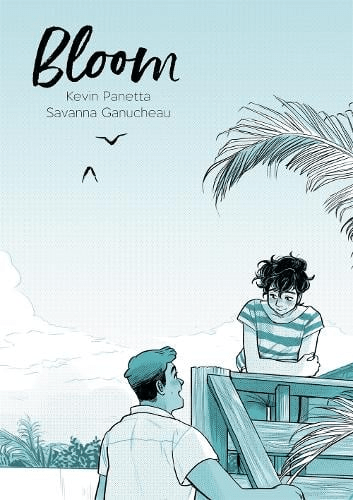
Bloom by Kevin Panetta and Savanna Ganucheau

Bloom by Kevin Panetta and Savanna Ganucheau is an absolutely gorgeous book. It reminded me a little of Heartstopper by Alice Oseman, both in terms of character design and artwork, which – since I loved Heartstopper – was a very good thing.

The story follows Ari, who wants to move away from his family bakery to play in a band with his friends. When baking-enthusiast Hector gets hired to help out after Ari is gone, Ari finds himself with a new reason to stay.

This is such a sweet romance – pun intended – and I loved the soft palette of grey-blue used throughout. I thought it really added to the mood. There were some moments where I wished that certain toxic friendships had been dealt with more instructively, but I do get that this is a representation of real-life struggles amongst teens/young-adults rather than a manual for How To Life. And I wish that there had been some more conversation about what happened following a certain altercation towards the end – Hector deserved better damnit – but overall, I thought that all the conflict was wrapped up nicely by the end.

This is another book for older readers, much like Boy Like Me, where it’s super easy to read alongside your child – the graphic novel format makes it quick, and it’s a breezy delight compared to the real world. Goodness knows I appreciated the happy place it provided for a few hours. And now I get to chat about lovely books with my eldest kiddo, which should keep the world at bay for a little longer.

Do you have any favourite graphic novels? Have you read Bloom, or Global, or The Power of Welcome? I would love to hear your thoughts and recommendations!


__
I’ve set up a ‘bookshop‘ of sorts, over on Bookshop.org, so that I can point you to somewhere to buy that isn’t Amazon. I get a small commission for any sales made there. This helps to support me running this blog. If you’d like to get your copy of Bloom this way, please just click here. If you’d like to support me without buying a book, you can do so here. Thank you.

Jamie by LD Lapinski

Jamie by LD Lapinski is an absolute beauty of a book. When Wonderland Books asked ‘Which children’s book have you recently read do you wish had existed when you were a child?’ this was the story which sprung to mind.

Jamie follows the eponymous, non-binary character as they transition up to secondary. With a town that only has an all girls- or all boys-school, Jamie needs to make a decision as to which they’ll attend. Sick of being forced into an arbitrary binary, Jamie and their friends decide to make a stand…

I’m never quite sure as to how much of myself to put into these reviews – it’s often difficult to strike a balance, given that books are art, and art solicits emotional responses. In this case though, I think it probably adds something to say that as someone who never really conformed to gender stereotypes, this book spoke to a part of me that as a child, would have found great comfort and solidarity in the character of Jamie. Am I non-binary? I don’t think so; agender, probably, but labels never seem to fit me with ease. Still, seeing someone defy the forced and artificial segregation of children would have soothed some part of my soul in early adolescence. I would have felt less broken growing up, and less at odds with the world.

There’s the old adage that we cannot be what we cannot see, and so books like this one are absolutely essential for young people. With such a small percentage of the population being trans, non-binary, and agender, it’s likely that a lot of young people will grow up without personally knowing anyone impacted by the themes in this book. For those who are gender non-conforming, readers can find a friend of sorts in Jamie. For those who aren’t, Jamie is a wonderfully sympathetic figure to root for, and can hopefully show that those outside the binary aren’t any kind of threat, despite the loud rhetoric in this increasingly transphobic world.

The clear importance of the book aside, Jamie is just a crackingly good story. It’s told with the humour that makes Lapinski’s books so deeply enjoyable, as well as the heart which makes them stay with you. The families seem real and… well, familiar, rather than the polished and sanitised versions that are so common in children’s literature. Parents are imperfect and relatable for adult readers, though are always clearly loving and doing their best.

Usually, when we finish a book, we pass it along to school so that a) we don’t drown in the number of books that pass through this house, and b) school’s library stays current. In this case, neither I nor the children could part with our copy of Jamie. So I bought school their own one. I can’t recommend this book enough.

Which begs the question: Which books do you wish existed when you were a child? Which books came into your life at just the right moment? I’d love to have a read.

___

I’ve set up a ‘bookshop’ of sorts, over on Bookshop.org, so that I can point you to somewhere to buy that isn’t Amazon. I get a small commission for any sales made there. This helps to support me running this blog. If you’d like to get your copy of Jamie this way, please just click here. If you’d like to support me without buying a book, you can do so here. Thank you.

Bambert’s Book of Missing Stories, by Reinhardt Jung

One of the things that I’ve missed most about the pre-Covid world, is the ability to browse. So many of my very favourite children’s books have been fluke finds in charity shops or the library. From The Year At Maple Hill Farm, to Rosy’s Garden and the myriad of titles in between, these small-print-run, out-of-print gems have quickly become family favoruites.

Bambert’s Book of Missing Stories by Reinhardt Jung is another book which fits this description.

I don’t know whether I can properly call this a ‘browsing’ find, but it was down to a hunger for running my fingers along a shelf of spines which led me to it. Bored, uninspired, and stuck in a rut, I went searching for videos of other peoples’ bookshelves on YouTube. I eventually stumbled on the videos of Leena Norms, and in particular, one of her bookshelf tours. And in that tour, she mentioned Bambert’s Book of Missing Stories.

At its core, this book is a collection of very short tales, but beyond that, it also chronicles the man who gathers these stories together. Old and in pain, the eponymous Bambert writes himself stories as a way to combat loneliness. One day, he settles on the idea of releasing his work into the world so that it can find its own setting.

I bought the book before I’d even finished hearing the plot.

I have always been, and always will be, a total romantic when it comes to story telling. The stories around stories – the tales of the writers and the bards – make my heart sing.

And Bambert’s Book of Missing Stories is that – a book about a book – but it’s also so much more.

The writer – Reinhardt Jung – was born in Germany in 1949, and some of the themes in Bambert’s tales seem to deal with the country’s fascist past. The text doesn’t do this overtly, but the story about the glass rafts is clearly about the concentration camps of the Nazi regime. Another two stories deal with war directly, with children as protagonists.

It might sound, at this point, like the book is a somewhat dark affair, but it really isn’t. Interlaced through the stories are insights into Bambert’s life, and the budding, gentle friendship which forms with the shopkeeper in the store below. It’s a rare tale about men befriending one another in a way that is supportive and caring. This happens so seldom in children’s literature that I feel it merits a mention.

A few points of note: the protagonist drinks to forget his pain, both he and the shopkeeper smoke cigars, and there is character death (though this is dealt with tenderly and poetically). The book touches on love and disability, and the fact that these things may not necessarily go hand-in-hand. It is a work which – for my part – I feel needs to be debriefed with older children, or read aloud to younger children to facilitate discussion about the events it contains.

But it should absolutely be read and enjoyed by children.

We don’t give young people enough credit for the levels of complexity that they’re able to process, and we can be neglectful when it comes to providing stories which deal in shades of grey, or which deal with death, or disappointment. But by showing them examples of these things in literature, we can better equip them for when life is less than ideal – by getting to know Bambert, for example, they might come to know that they’re not alone in feeling lonely.

I would love to hear your opinions on Bamburt’s Book of Missing Stories, if you’ve read it. And I would love to hear if you know of any other books which provide challenging content.

Love,

Farn ❤

M is for Autism by The Students of Limpsfield Grange School & Vicky Martin

M is for Autism is a book by The Students of Limpsfield Grange School & Vicky Martin.

I definitely think that this is essential reading – not just for children/young teens, but also for their parents. The searing truth with which its written makes it one of the clearest, most concise insights into what life is like as an autistic person that I have read.

There were two sections which really stood out for me as being especially piercingly honest.

The first is from M’s perspective and concerns her feelings following her diagnosis;

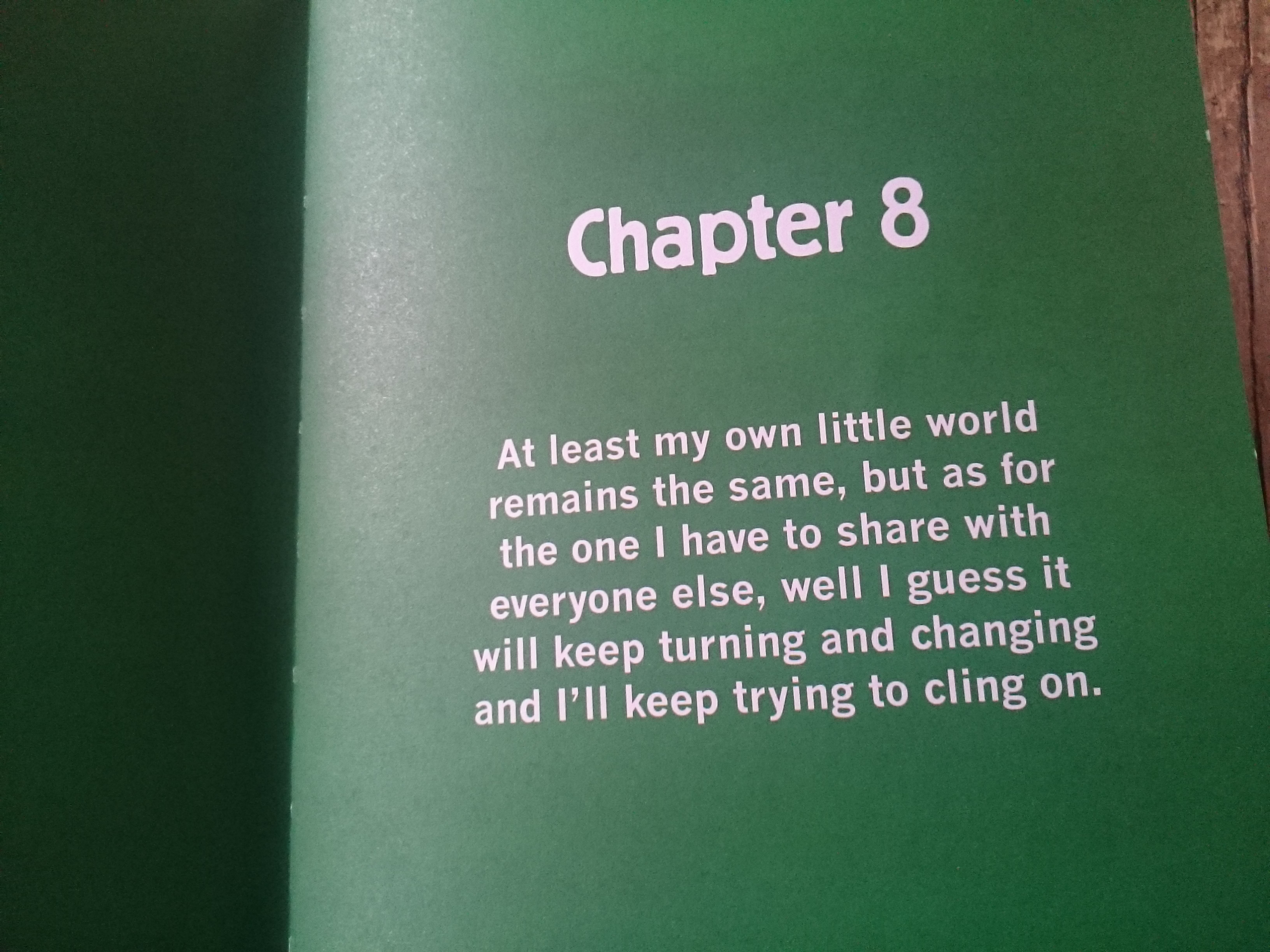
It’s like I can be shelved correctly or put in the right section. I mean, do people even know what being autistic is? The truth is they don’t really know me. I wonder if they really knew me they might get scared, so it’s easy for them to say ‘she’s autistic’ and label me but the truth is they have no idea of the shape, texture and size of my world.

The next is from M’s mother’s point of view;

So here I am, chopping onions and trying to bond with my beautiful daughter but it’s not easy. It should be, shouldn’t it? But reaching her and connecting with her feels so hopeless, so futile, but today I am making a big effort. I am her mother and I cannot give up on her or let her down.

The prose is this vital, this direct, throughout the book. So, although it’s a very slim volume which reads really naturally, it actually took me a long time to digest the words properly – I took my time over it, which I think everyone who reads it needs to do.

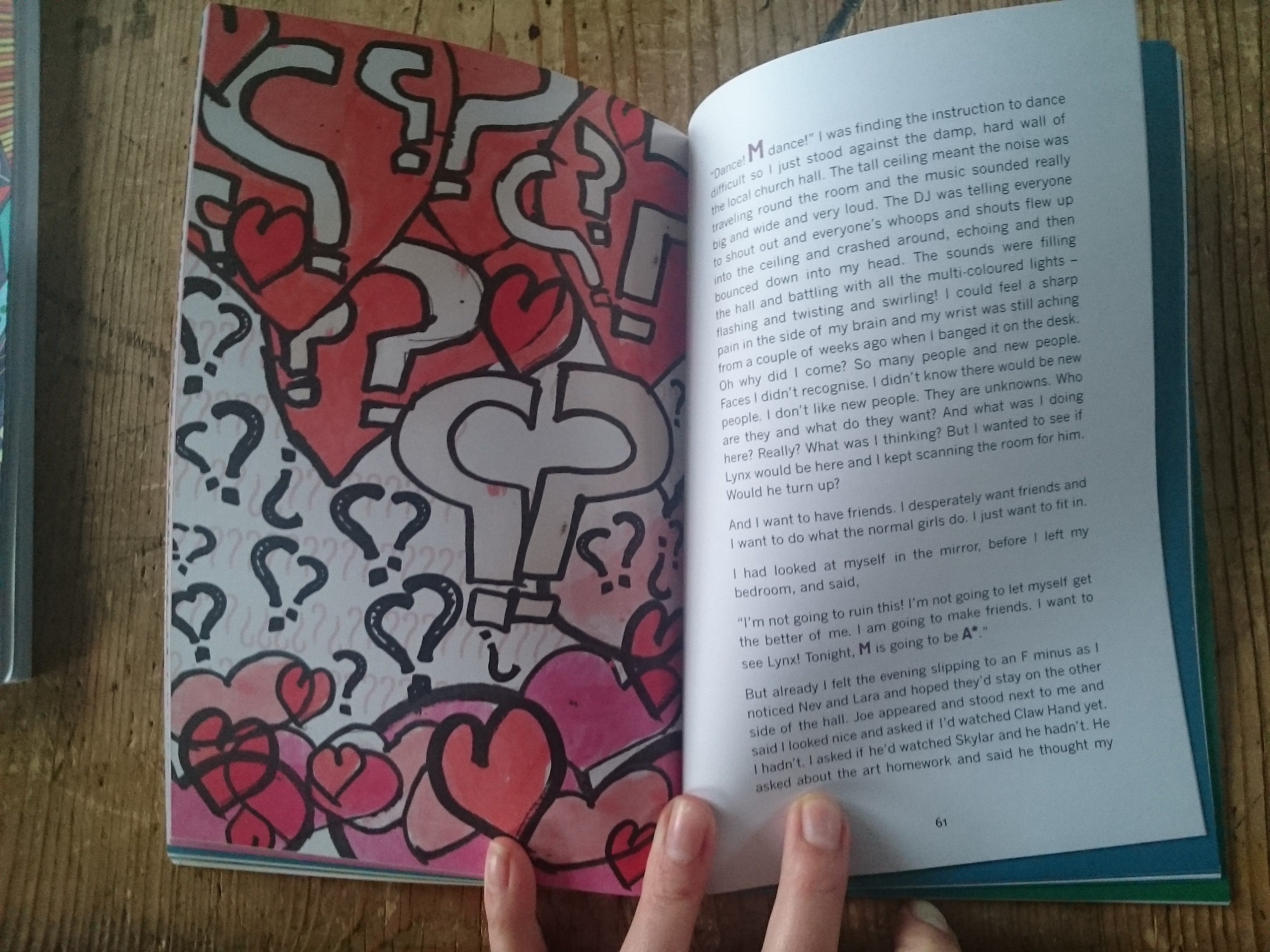
The artwork is also really honest – bright, block colours and really graphic prints. The art can be quirky and fun whilst simultaneously thought-provoking, generally just suiting the age and feel of the protagonist perfectly.

I feel as though this is one of those books which every home needs – whether autism impacts you directly or not. If everyone read this, there might be a greater degree of understanding and awareness in the world.

Have you read M is for Autism, or another book with a female autistic character?

— Farn ❤

Follow my blog with Bloglovin

Super Duper You by Sophy Henn

I really liked Sophy Henn’s book, Pass It On, so when I saw she had written Super Duper You, we checked it out of the library and took it home for a read.

Before I start, talking about the book-proper, I just wanted to say that even though our house seems to be constantly overflowing with books, I don’t often buy them. Generally, we only really use the library, read a story until everyone is tired of it and then take it back, knowing that should we want to read it again we only need to place our order and then go to pick the book up.

Generally…

Every so often though, we read a book and I want to own  it. Super Duper You is one of those. It’s got shades of ‘Oh! The Places You’ll Go!’ by Dr Seuss to it, but it’s vastly more succinct and I love that it’s accessible to even the smallest of listeners. Again the art-work is modern and bright and pleasing. Again, I feel like my accent works against me with the rhyme.

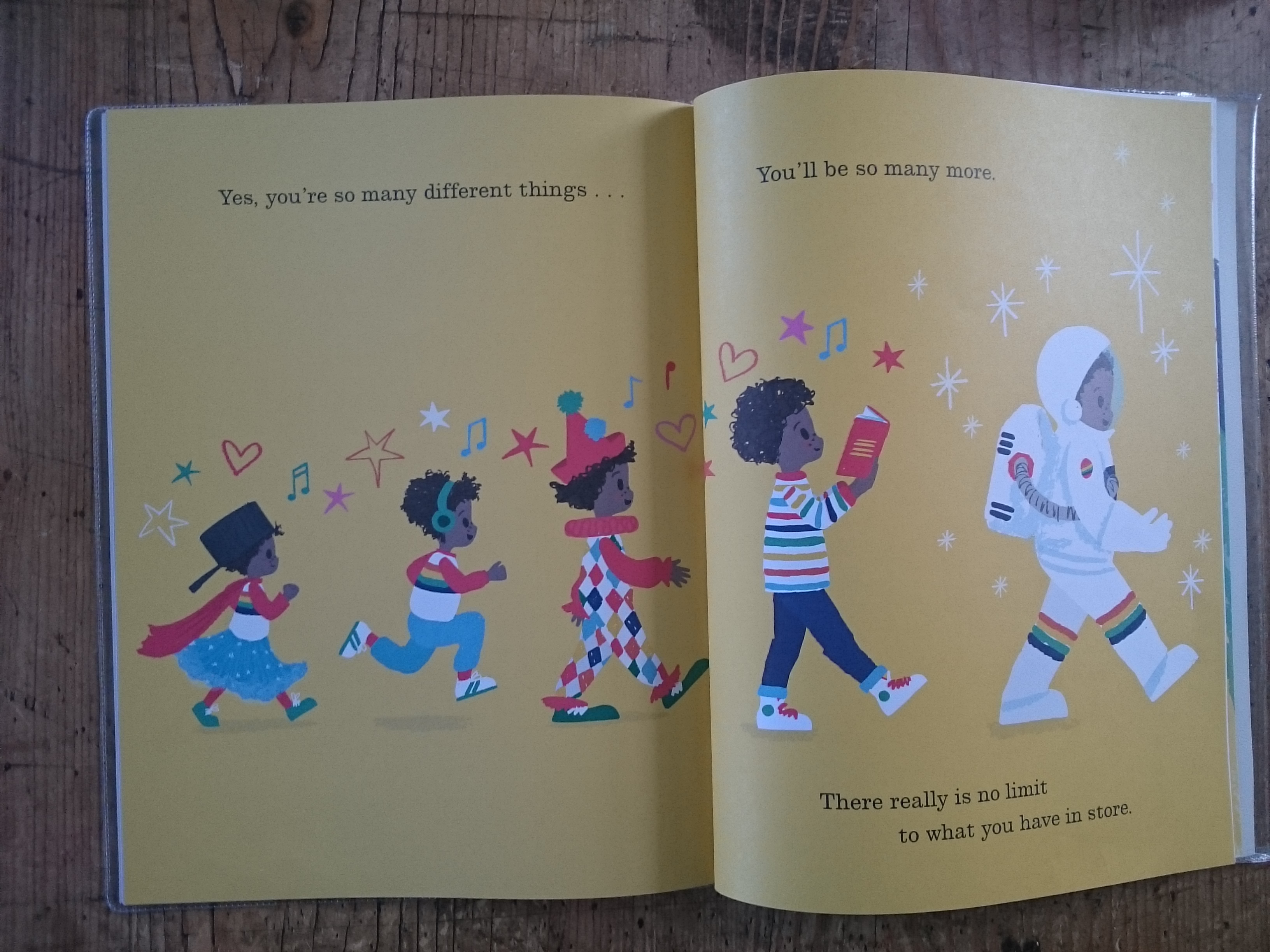
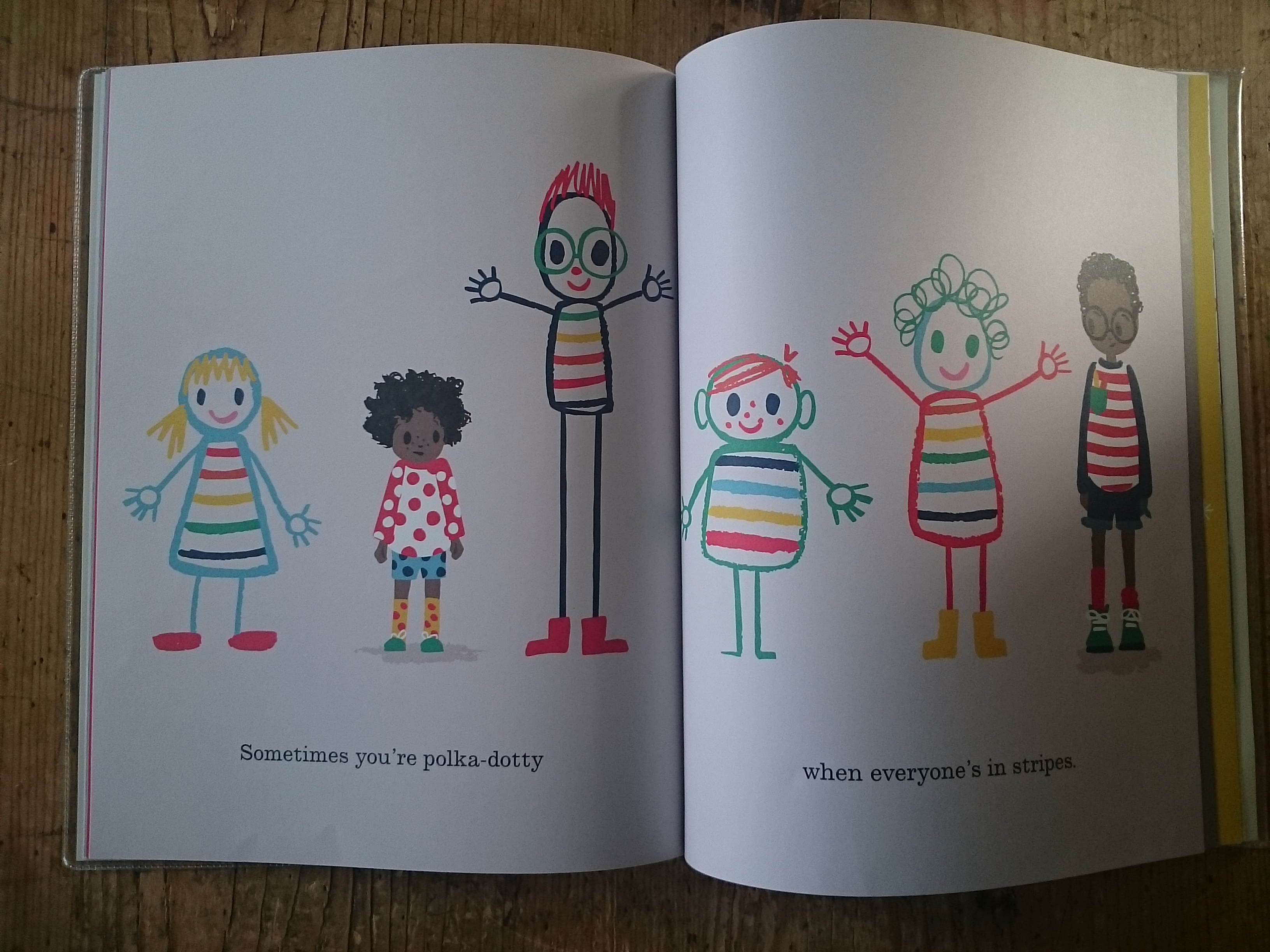
I think I love the illustrations and the colours of this book most of all – especially the rainbows and the quirky background ‘grafitti’. I wish my big, special camera was more cooperative so I could take better photos for you, but for now you’ll have to make-do with my tablet’s lens and have a look the book for yourself… 😉

I think the page above is my favourite. It can be used in conjunction with other books to start conversations about the positives of neurodiversity, or about differences in family situations – or about anything, really..

I also really like the fact that it is a love-letter between siblings. There are lots of books which explore the parent/child relationship, but off the top of my head, the only nurturing siblings I can think of are Lauren Child’s Charlie and Lola or The Restless Girls by Jessie Burton. It makes a nice change from the usual ‘my brother smells’ dynamic that seems so prevalent in children’s books.

Have you come across Sophy Henn’s work yet? I’d love to hear what you think.

  • Farn ❤