Youngest kiddo seems to have developed a taste for writing reviews, and who am I to say no? Here’s another review by my smallest bookworm about one of our absolute favourites this year, Rory and the Snack Dragons by the lovely Louisa MacDougall.
I absolutely loved the sense of fun in this book – I don’t want to spoiler anything, but bicycles feature heavily, and crunchily, as does my own favourite vegetable, the sprout. Honestly, if this isn’t on your shelf yet, then you won’t regret buying a copy. It feels like the sort of story created by parent-and-children in tandem, giggling past bedtime – a real slice of goofy magic and nostalgia. I can’t recommend it highly enough.
I first read an extract of this book before it was published because it was shortlisted for the Kelpies Prize 2022. I was really excited that it was getting published and couldn’t wait for it to come out. 😉
Rory and the snack dragons is a fantastic book for children AND adults. I really liked that Rory was not considered a villain like most dragons are, because it means that it can give the reader a different kind of main character. I also liked that it shows that not all books have to be serious. I mean I`ve never read any classics and serious books are good but it gives you a nice quick break.
ANOTHER REVIEW BY YOUNGEST, AGE 9 😉
—
I’ve set up a ‘bookshop‘ of sorts, over on Bookshop.org, so that I can point you to somewhere to buy that isn’t Amazon. I get a small commission for any sales made there. This helps to support me running this blog. If you’d like to get your copy of Rory and the Snack Dragons this way, please just click here. Thank you for your support.
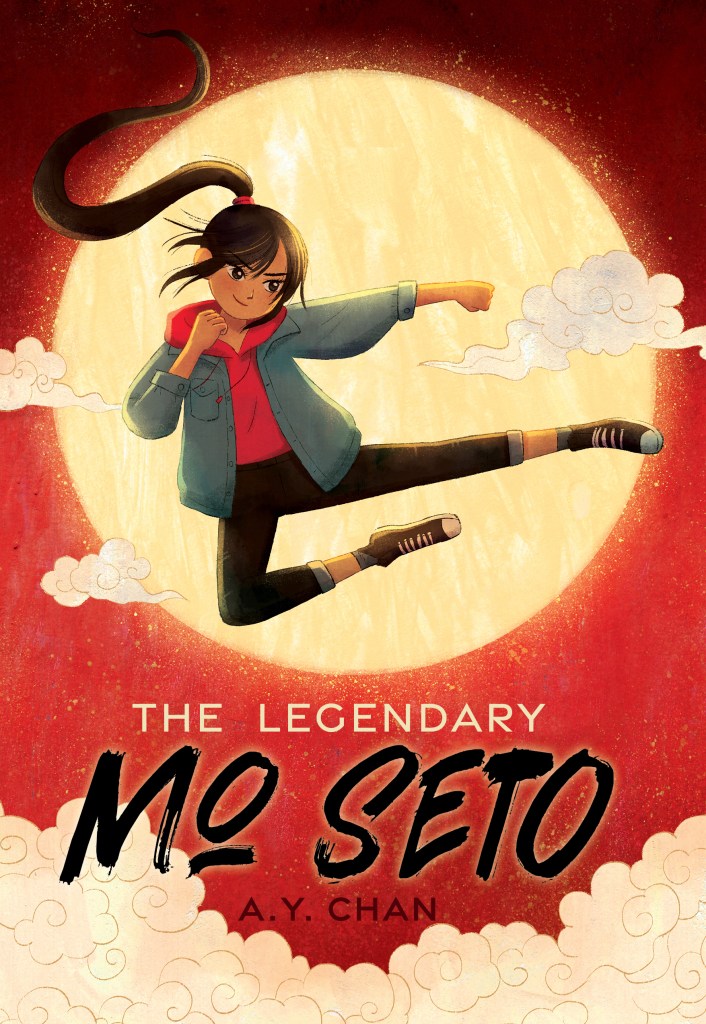
The Legendary Mo Seto is an absolutely glorious book, full of warm characters and adventure. There is so much to love about this novel – from the tight plot, to the lovely details that make Mo feel real (for example, the fact that she says every film starring her favourite actor is the best movie ever).
I could honestly rave about this story for days, but I think more telling than anything is that fact that my husband who doesn’t read has run off with our copy of the book! And my nine year old askedme if he could write the review! So here it is!
Mo Seto is an amazing book filled with action excitement and wonderful friendships. I really enjoyed that the main character [Mo] has got growth problems and that it shows that just because you are small doesn’t mean you’re not strong. I also like that it is based in Canada because most books are set in places like London or America. It was a bit of a slow start but it quickly became an unputdownable book and I defo think it should have a sequel because it was SO, SO, SO, SO, SO good! And it was actually one of the best books if you could get through the tiny window of a slow start.
By Youngest, age 9*
Book Blurb: Mo Seto, martial arts movie star! Has a nice ring to it doesn’t it? If only there wasn’t a height restriction to audition. But 12-year-old Modesty (Mo) Seto has never let her height get in the way before, not when she became a black belt, or when she fought the meanest boy in her class, and she’s not going to let it stop her this time! Now if only she can figure out a way to grow five inches and fool everyone at the auditions… Join Mo on an adventure (and audition) of a lifetime and find out if powerful things really do come in small packages!
About the Author: A.Y. Chan is the author of The Legendary Mo Seto, a story about a 12-year-old female martial artist who auditions for a movie role opposite her favourite martial arts movie hero—only to find out she’s too small for the role. Growing up in Canada’s Greater Toronto Area, A.Y. read all the middle grade and young adult books she could get her hands on. To this day, those remain her favourite genres. After achieving her black belt in Taekwondo, she explored a range of other types of martial arts, and she draws upon her experiences in learning new techniques and philosophies to inspire her writing. These days, she continues her martial arts training some mornings, writes in the afternoons, takes long walks to muddle out plot points, and falls asleep reading.
Why A.Y. Chan wrote this book: I started training in taekwondo when I was six and, growing up, I longed to read books about kick-butt girls doing kick-butt things, but there really weren’t as many as I had hoped for. The idea for this book has been percolating in my head ever since. I wish to inspire kids not only to be brave and never give up, but also to be proud of who they are.
My inspiration for my story came from a real city-wide competition, where, like Mo, my protagonist, I faced off against a bigger, stronger boy during the final match. At that time, pairings were determined by belt-level and age, not by weight class. I ended up losing. I remember feeling so crushed by my second-place finish, and I kept replaying the fight in my head, wondering what I could have done differently.
I was also inspired by martial arts movies—especially the stunt actors and body doubles, and the thugs in the background serving as punching bags for the protagonist. As an introvert, I never wanted to be the main character…but to get beat up by the main character? That seemed awesome. After achieving my black belt in Taekwondo, I explored other types of martial arts and came away with an appreciation for the similarities and differences in the different forms, and how each has a unique philosophy linking the physical to the mental (and spiritual). Martial arts is about discipline and practice, but it’s also about respect (for oneself and for others) and integrity. And, of course, indomitable spirit, the all-encompassing light within us all that shines with determination and hope and an unshakable optimism for a brighter tomorrow.
___
*The book is actually set in California, but for the purposes of not putting the kid off writing reviews, I left everything as it was originally penned so that Youngest could see their exact words online.
___ I’ve set up a ‘bookshop‘ of sorts, over on Bookshop.org, so that I can point you to somewhere to buy that isn’t Amazon. I get a small commission for any sales made there. This helps to support me running this blog. If you’d like to get your copy of The Legendary Mo Seto this way, please just click here. Thank you for your support.
The story follows Mani in the wake of her father’s disappearance. Choosing to disobey his instructions to ‘stay put’ when her food supply runs out, Mani meets Leo – a scientist – who makes a remarkable discovery. Mani is immune from the disease that killed her mother and a large portion of the population.
The book is set in a post-apocalyptic world. As the icecaps melted, they left behind a disease which impacts the way human bodies interact with electricity. There’s an element of The Last of Us to this – a man and a girl journeying across a landscape devoid of hope in an attempt to deliver a cure.
But it’s also more than that. Mani has inherited a wooden mask – an artefact that lets her escape to another world where she can communicate with animals. I thought that this was a really unique touch – I’ve come across a lot of dystopian books, but few which incorporate fantasy elements into the end of the Anthropocene.
This is definitely a book for the older end of the MG spectrum, pushing into YA. I know that my youngest (9) wouldn’t be able to cope with the ingenious use of seal bodies for raft building, for example, or the bodies of people that are found in the cottage along Mani and Leo’s journey to the Ark.
I’ve spoken before about how I feel about dystopian books in general – specifically in regards to Feast of Ashes and The Remembering. Whilst Maxwell very much hits similar notes to Williamson, this book doesn’t feel anywhere near as bleak. The way in which Mani makes use of the plastic bottles left behind by our generation, or the way Tilde uses an old truck as a look-out post feels so much more… human. No, it’s not as hopeful as Orrom’s work, but it does show a way forward in which people make the best of a situation, and I think that’s fundamentally human nature. People are wonderful – our systems are not.
There’s a lot more I could say about this book, but as a story that’s heavily plot-driven, I don’t want to give too much away. I would definitely urge you to pick up a copy, and I’ll be waiting for the next instalment.
About the Book:
Book 1 in an action-packed dystopian adventure series set in the near-future post-melt Arctic.
The last ice cap has melted, and the world is on the brink of collapse. A deadly force—Terra Electrica—has been unleashed. It feeds on electricity. It is infecting civilization.
In this chaotic, rapidly changing reality, 12-year-old Mani has lost her family and community to the Terra Electrica. Armed only with some ancestral wisdom and a powerful, ancient wooden mask she was never meant to inherit so soon, she suddenly finds herself responsible for the fate of the world.
Can Mani piece everything together and harness her newfound powers in time to save humanity?
About the Author:
Antonia Maxwell is a writer and editor based in North Essex and Cambridge, UK. With a degree in Modern Languages and a long-standing career as a book editor, she has a lifelong curiosity for language and words, and a growing fascination in the power of story – the way it shapes our lives and frames our experience.
___
I’ve set up a ‘bookshop‘ of sorts, over on Bookshop.org, so that I can point you to somewhere to buy that isn’t Amazon. I get a small commission for any sales made there. This helps to support me running this blog. If you’d like to get your copy of Terra Electrica this way, please just click here. Thank you for your support.
There’s a lot to talk about when it comes to The Remembering by Dione Orrom, and honestly, I’m not really sure where to start.
Simply put, this book is a journey through a dying landscape, in a last-ditch attempt at saving the world from the environmental mistakes of humanity. There were shades of The Neverending Story to this – a race through a collapsing world which emphasises the beauty of things through their absence. There’s also what feels like a nod to The Lion, The Witch, and the Wardrobe – a collection of disparate animals coming together to fight against dark forces. There’s so much to like about this book and so much that makes it timely.
But let’s start at the beginning which – honestly? – is going to put some people off. So, while I’m saying this, please keep in mind that I loved the rest of the book. Really, actually loved it. The thing is though, the first three chapters are… slow. And in chapter 2, especially, there’s a lot of exposition through conversation. That’s not necessarily a bad thing, but when the rest of the book is so fluid and pacy, it felt jarringly clunky. Youngest child (9) gave up, and Eldest (13) said it was a close call.
I think this is partially down to how rich the lore of Orrom’s world is – how much there is to say about every aspect of what’s going on. As the story continues, the quick pace and sense of urgency makes the book very difficult to put down. I read a digital copy, and though the first 20 pages or so were difficult to get through, I found myself at 72% finished by the point it was so far Past My Bedtime that I had to stop reading. I finished the rest first thing the following morning.
As I said above, this story pulls together lots of elements from classic children’s literature. In addition to The Neverending Story, and C.S. Lewis’s cornerstone of children’s fantasy, I could see shades of Michelle Paver’s Wolf Brother series in the characters of Snakeskin and Aster. There are echoes of Elidor in the way that the children only ever know part of what’s going on – there’s the sense that they’re minor characters in a much larger adventure. Some of these books, are amongst my all time favourites.
I think though, as a keen forager, that what I loved most about The Remembering was the way that time-travel seemed to work through the mitochondrial root network that connects tress to fungi. I thought this was absolutely genius and loved the way that Orrom continued this tree-inspired lore throughout. I loved that the trees of the council each had their own personalities and roles to play. Honestly, chef’s kiss to all the lore of this world.
I spoke a little while ago about dystopian climate fiction and how I don’t think it’s the way to engage people with the realities of climate crisis. I passionately believe that we need a future to fight for, more than we need one to steer from. Though it’s never explicitly stated whether Snakeskin and Aster exist in the past or the future of Jack’s time, the closeness that they share with the natural world is something that we can all aim for. Perhaps not literally speaking to the trees – though you never know – but by engaging with the world as a part of it, rather than master of it.
To sum up – if you’re reading this as an adult, stick with it past the first few chapters – you won’t be disappointed. If you’re reading this with children, perhaps read the first five chapters or so together, before handing the book across*.
What are your favourite climate fiction books? I’d love to read some – especially those which offer a vision of hope, rather than dystopia.
___
*This works for Youngest child. Sometimes they’re** convinced that a book with smaller writing is ‘too hard’ so we read the first few chapters together (take a page, turn about), and by the time we get to chapter 2 or 3, kiddo is ready to read the rest alone.
**I’m using the singular ‘they’ pronoun for anonymity, rather than gender reasons, though if you do have recommendations on books for non-binary children, I’d love to hear them.
___
I’ve set up a ‘bookshop‘ of sorts, over on Bookshop.org, so that I can point you to somewhere to buy that isn’t Amazon. I get a small commission for any sales made there. This helps to support me running this blog. If you’d like to get your copy of The Remembering this way, please just click here. Thank you for your support.
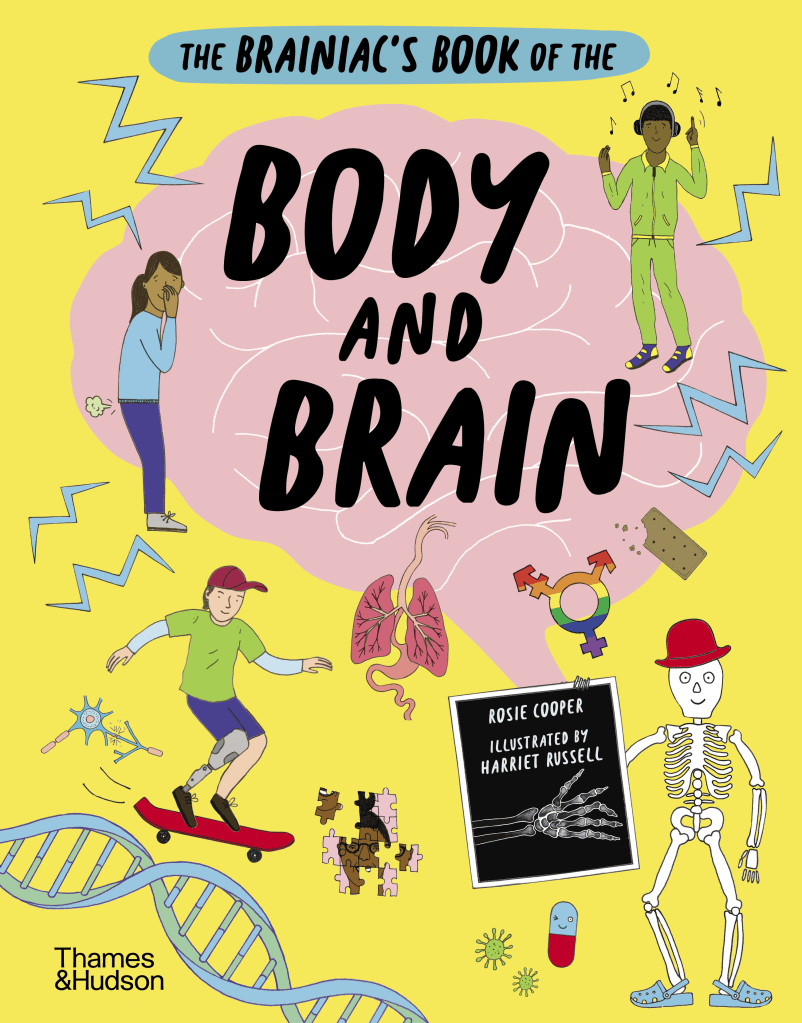
The Brainiacs Book of Body & Brain by Rosie Cooper is another beautiful picture book from Thames and Hudson. It is full of bright, fun, artwork and really clearly explained facts.
This book deals with a lot of the sorts of questions that young people have about their own – and other peoples’ – bodies, doing so with humour and authority.
I especially appreciated the sections on senses and sensation. As a household full of neurodivergent people, we often have questions regarding why things feel the way they do – for example, the shivering associated with cold can be mistake for a fear response by autistic brains – so having a clear, concise reference point like the ‘Spooky Sensations’ page in this book is fantastic. It’s a great way of explaining relatively complicated concepts such as ‘proprioception.’
Spreads include the mandatory ‘fart’ pages, but there’s also the joyfully revolting ‘Bathtubs of Sweat’ – a gross bodily fluid that’s often overlooked in favour of more mundane offerings like pee and poop.
And apparently, as a parent and book reviewer, these are sentences that I can authoritatively write now.
Hmm.
Not sure how I feel about that.
Regardless, if you’re looking for a book about the body that goes beyond the usual ‘the bones are scaffolding and your muscles make you move’ then this is a fabulous option, guaranteed to provide giggles along the way.





 THE INQUISITIVE NEWT